H. Moser & Cie. has a habit of making complicated watchmaking look deceptively simple, and the Endeavour Flyback Chronograph Dual Time Date Ref. 1730-1200 is a strong example of that approach.
Launched on 27 May 2026, the watch brings together a flyback chronograph, dual time display and date inside a polished steel Endeavour case, yet the dial remains almost aggressively clean.
That restraint matters because this isn’t just a tidy layout exercise. It’s a technically dense travel chronograph built around a hand-wound calibre developed with AGENHOR.
Quick summary
- H. Moser & Cie. introduces the Endeavour Flyback Chronograph Dual Time Date Ref. 1730-1200.
- The watch combines a central flyback chronograph, dual time display, date and movement-side power reserve indicator.
- Its hand-wound HMC 730 calibre was developed with AGENHOR and offers a minimum 72-hour power reserve.
- The 42mm polished steel case is priced at 59,000 CHF excluding VAT.
A counter-free travel chronograph
The first surprise is how little the Endeavour Flyback Chronograph Dual Time Date shows at a glance.
There are no subdials, no running seconds counter, and no applied hour markers competing with the complications.
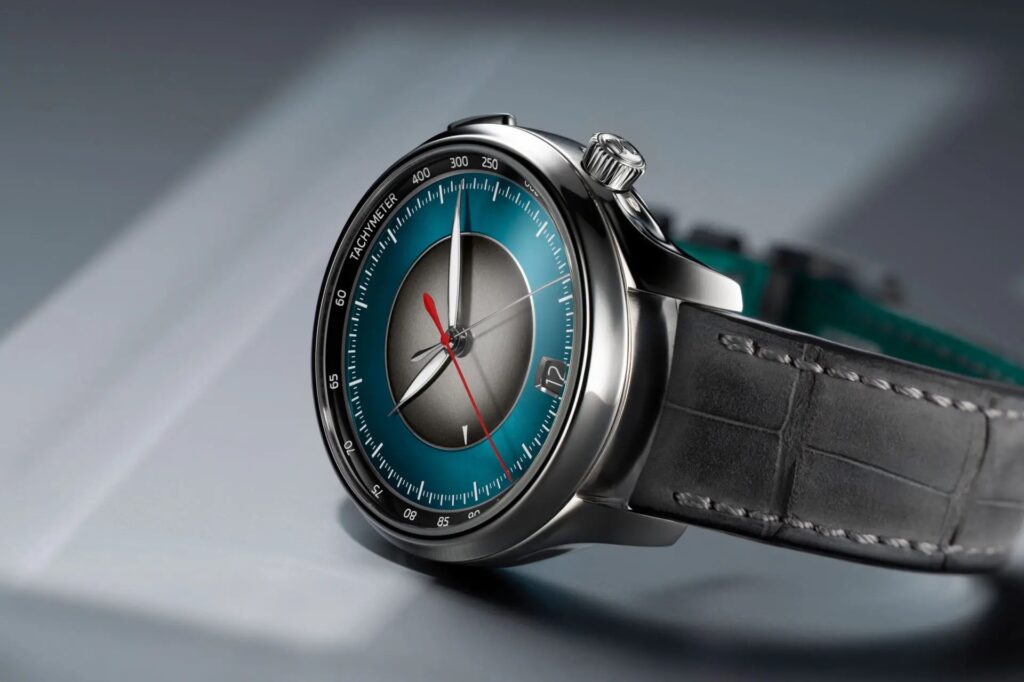
Moser splits the dial into two visual zones. The outer turquoise fumé sunburst ring carries the leaf-shaped hour and minute hands, both filled with Super-LumiNova, along with the date window at 6 o’clock.
A white minute track around that outer section also handles elapsed chronograph readings, while the tachymeter scale is pushed out to the flange to preserve the dial’s open surface.
The centre of the watch is a Blackor fumé sunburst disc for the dual time function. A slim white arrow, also treated with Super-LumiNova at its tip, indicates the second time zone without needing an extra subdial.
The chronograph is fully central. A red hand records elapsed seconds, while a rhodium-plated hand tracks elapsed minutes through a retrograde mechanism.
It’s an unusually direct way to read a chronograph, especially for a watch that also has travel functionality and a date.
The HMC 730 was built to make space
Inside the watch is the hand-wound HMC 730, a calibre developed by H. Moser & Cie. with Geneva movement specialist AGENHOR.
The architecture has a direct link to the automatic HMC 902 used in the Streamliner flyback chronograph, but here the automatic winding system and rotor have been removed.
That decision frees room for the dual time disc and date mechanism while keeping the movement at 34.4mm wide and 7.2mm thick.
The numbers are serious. The HMC 730 uses 383 components, 49 jewels, twin barrels and runs at 21,600 vibrations per hour, with a minimum power reserve of 72 hours.
The chronograph uses a column wheel and a two-stage mechanism, with a horizontal clutch fitted with a friction wheel and patented micro-teeth designed to smooth engagement.
A tulip yoke manages chronograph triggering and release, while the flyback function resets both the elapsed seconds and minutes together.
The elapsed minutes do not simply creep around a conventional subdial. They use a retrograde snail cam system that accumulates energy as the minute hand advances, then releases it instantly when the hand returns to zero.
Moser has also kept the power reserve indication on the movement side, visible through the sapphire case back rather than placed on the dial.
The finishing follows the brand’s familiar anthracite treatment with Moser double stripes, and partially skeletonised bridges give the calibre a more architectural view from the back.
One of the most practical details is the date adjustment. It can be corrected forwards or backwards without risking damage to the movement.
The Endeavour case stays formal but purposeful
The watch sits in a polished stainless steel Endeavour case measuring 42mm across and 13.2mm thick.
Those dimensions put it firmly in contemporary chronograph territory, though the curved lugs and clean case profile keep the design closer to refined dress-sport than instrument watch.
The chronograph pushers are placed at 10 and 2 o’clock, a layout that gives the watch a balanced, almost bullhead-like stance without disrupting the round case.
The screw-down crown is positioned at 4 o’clock and engraved with the Moser “M”.
Water resistance is rated to 3 ATM, which suits the watch’s polished, travel-oriented character rather than positioning it as a hard-use sports chronograph.
It comes on a grey alligator strap with a nubuck finish, secured by a steel pin buckle engraved with the Moser logo.
At 59,000 CHF excluding VAT, the Endeavour Flyback Chronograph Dual Time Date is positioned for collectors who care as much about movement architecture and dial discipline as they do about the complication count.
Its real appeal is that it doesn’t look like a watch trying to prove how much it can do, even though the mechanics underneath are doing plenty.
Confirmed details at a glance
| Brand | H. Moser & Cie. |
|---|---|
| Model | Endeavour Flyback Chronograph Dual Time Date |
| Reference | 1730-1200 |
| Case size | 42.0mm diameter, 13.2mm thick |
| Case material | Polished stainless steel |
| Dial | Turquoise fumé sunburst outer dial with Blackor fumé sunburst centre disc |
| Movement | Hand-wound HMC 730 developed with AGENHOR |
| Complications | Central flyback chronograph, dual time, date, movement-side power reserve indicator |
| Frequency | 21,600 vibrations per hour |
| Power reserve | Minimum 72 hours |
| Components | 383 components, 49 jewels |
| Water resistance | 3 ATM |
| Strap | Grey alligator strap with nubuck finish and steel pin buckle |
| Price | 59,000 CHF excluding VAT |
FAQ
Who is behind this?
this story is best understood through the person, studio or creative practice described in the article, rather than as a single product release.
What makes the dual time important on this watch?
Moser’s Endeavour Flyback Chronograph Dual Time Date keeps three complications neatly under control The new H. H. Moser’s Endeavour Flyback Chronograph Dual Time Date combines a flyback chronograph, dual time and date with the hand-wound HMC 730 calibre.
Why does this appeal to collectors and design fans?
It appeals because it translates a collecting interest into a more personal visual or cultural object, rather than focusing only on specifications or ownership.
How does this connect with watch culture?
The connection comes through the watches, brands, collectors or horological details discussed in the article, but the main subject is the creative interpretation around them.
Can collectors commission or buy work from this?
It appeals because it translates a collecting interest into a more personal visual or cultural object, rather than focusing only on specifications or ownership.