David Candaux has returned to the watch that set the tone for his independent atelier, and this time he’s given it the weight and difficulty of platinum. The DC1 Platinum Art of the Tourbillon is limited to eight pieces, but the number only tells part of the story. This is a compact showcase of stone work, titanium movement architecture and one of the more considered inclined tourbillons in modern independent watchmaking.
At a glance
- David Candaux has introduced the DC1 Platinum Art of the Tourbillon as an eight-piece limited edition.
- The watch pairs a platinum case with a layered black onyx and white opal dial, plus an in-house H74 calibre with a 30-degree flying tourbillon.
- It is priced at CHF 248,000 and comes on a textured black rubber strap with a 10-year warranty.
The DC1 Platinum Art of the Tourbillon is the first platinum interpretation of Candaux’s DC1, the watch that introduced his personal design language in 2017.
For a maker working from Solliat in the Vallée de Joux, the move into platinum feels deliberate rather than decorative. The architecture remains unmistakably DC1, but the material shift gives the watch a denser, more formal character.

A dial built like a miniature landscape
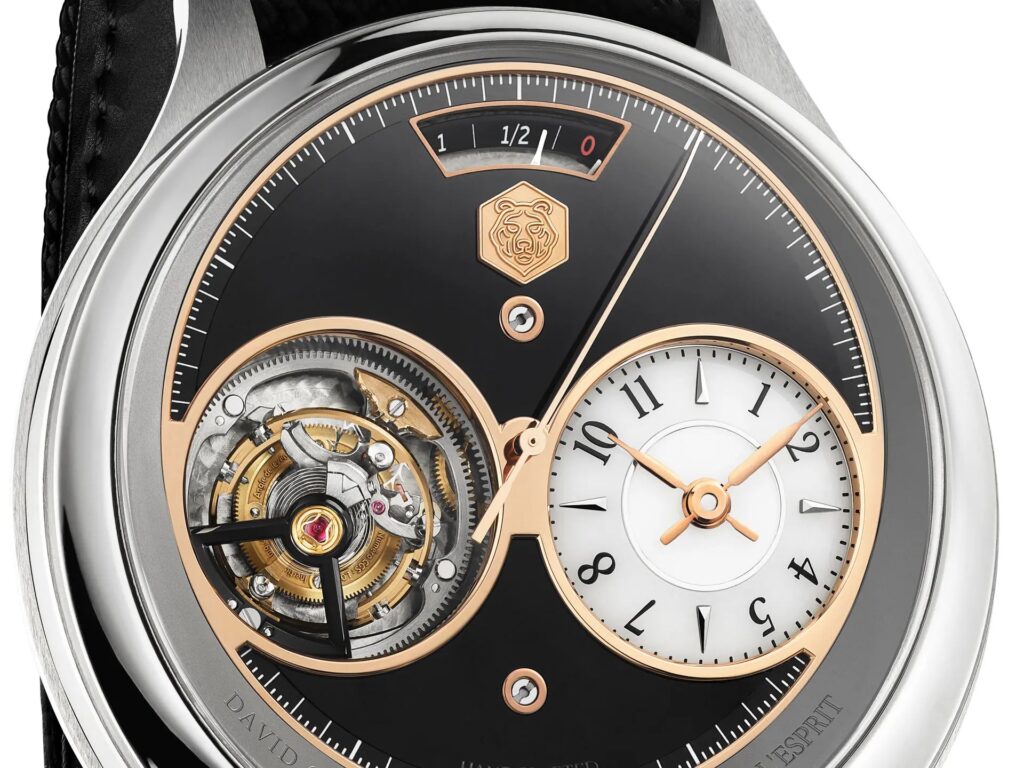
The dial is not a flat display so much as a layered construction, with around a dozen separate components arranged beneath an asymmetrical sapphire crystal.
At the centre sits a mirror-polished black onyx plate measuring just 0.2 mm thick. That extreme thinness makes the stone highly fragile, with several blanks required to complete one finished plate.
The visual payoff is a deep, almost liquid black surface that pulls attention toward the tourbillon aperture at 9 o’clock.

Time is shown on a domed white opal micro-dial at 3 o’clock. The faceted stone shifts with light, appearing more translucent indoors and brighter outside.
Rose gold flanges frame the hour-and-minute display and the tourbillon opening, while the applied bear emblem, hand-bevelled details and polished surfaces keep the composition warm against the dark stone.
The H74 calibre uses titanium in a serious way
The in-house H74 calibre is built around Grade 5 titanium bridges and mainplate, a signature choice for Candaux across his movement work.

Titanium brings low weight, corrosion resistance, anti-magnetic properties and thermal stability, but it also makes hand-finishing more demanding than with traditional brass or German silver.
The finishing brief is extensive. The movement includes 18 mirror-polished recessed domed angles, drawn lines, circular graining beneath the bridges and Candaux’s Côtes du Solliat decoration across the visible bridge surfaces.
The calibre is tilted three degrees inside the case, creating a sense of mechanical depth through the sapphire back. The bridge layout appears to cascade away from the eye rather than sit in a single plane.

The flying tourbillon is inclined at 30 degrees, which gives it more practical purpose than a conventional flat tourbillon in a wristwatch. By travelling through varied positions during each 60-second rotation, the cage can average positional errors more efficiently during wear and while resting.
The tourbillon cage is made from 27 components and weighs only 0.35 grams. Its black anodised titanium surface is achieved through micro-arc oxidation, which transforms the outer layer into a ceramic-like structure integrated into the metal.
Platinum adds weight and difficulty
The case measures 43 mm across and 12.90 mm thick including the crystal, with an asymmetrical profile running from 6 to 12 o’clock and symmetry across the 3-to-9 axis.

Platinum is unforgiving at the bench. It clings to tools, records every pass and requires careful reworking around sharp transitions before final polishing.
The finished case uses satin, brushed and fully hand-polished surfaces, with raised engravings for “Tourbillon 30°,” “David Candaux” and “Waterproof 30m.” Water resistance is rated to 30 metres.
At 6 o’clock is Candaux’s patented Magic Crown, a retractable 31-component pusher system tested 28,000 times. Here it combines a natural titanium body with a platinum cap, making the material contrast visible rather than hidden.

| Model | David Candaux DC1 Platinum Art of the Tourbillon |
|---|---|
| Case | Platinum, asymmetrical profile |
| Diameter | 43 mm |
| Thickness | 12.90 mm including crystal |
| Water resistance | 30 metres |
| Movement | In-house H74 manual-winding calibre |
| Tourbillon | 30-degree inclined flying tourbillon |
| Frequency | 21,600 vibrations per hour |
| Power reserve | 55 hours |
| Jewels | 47 jewels with half-pavé settings in solid gold mounts |
| Components | 287 total movement components |
| Dial materials | Black onyx, white opal, 18-karat rose gold details |
| Strap | Textured black rubber with Velcro buckle and quick-release system |
| Limited edition | 8 pieces |
| Price | CHF 248,000 |
| Warranty | 10 years |
Who this watch is for
The DC1 Platinum Art of the Tourbillon is not aimed at collectors chasing a familiar prestige name or a safe complication.
It will speak more directly to enthusiasts who understand independent watchmaking as an exchange between engineering, risk and visible handwork.
The CHF 248,000 price places it in rarefied territory, but the appeal is specific. This is a watch for someone who values a maker’s first architecture, reworked at a higher material and finishing threshold, rather than a new shape created simply to mark a limited edition.

With only eight pieces planned, the DC1 Platinum Art of the Tourbillon is less about expansion than refinement. It revisits the idea that launched Candaux’s independent path and gives it a heavier, darker and more technically resolved presence.
FAQ
How many David Candaux DC1 Platinum Art of the Tourbillon watches will be made?
The watch is limited to eight pieces.

What makes the dial unusual?
It uses a layered construction with a very thin mirror-polished black onyx plate, a domed white opal time display and rose gold framing elements.
What is special about the tourbillon?
The flying tourbillon is inclined at 30 degrees, allowing it to move through a wider range of positions during each one-minute rotation.
What movement powers the watch?
It uses the in-house manual-winding H74 calibre with Grade 5 titanium bridges and mainplate, 47 jewels and a 55-hour power reserve.
What is the price of the DC1 Platinum Art of the Tourbillon?
The listed price is CHF 248,000.