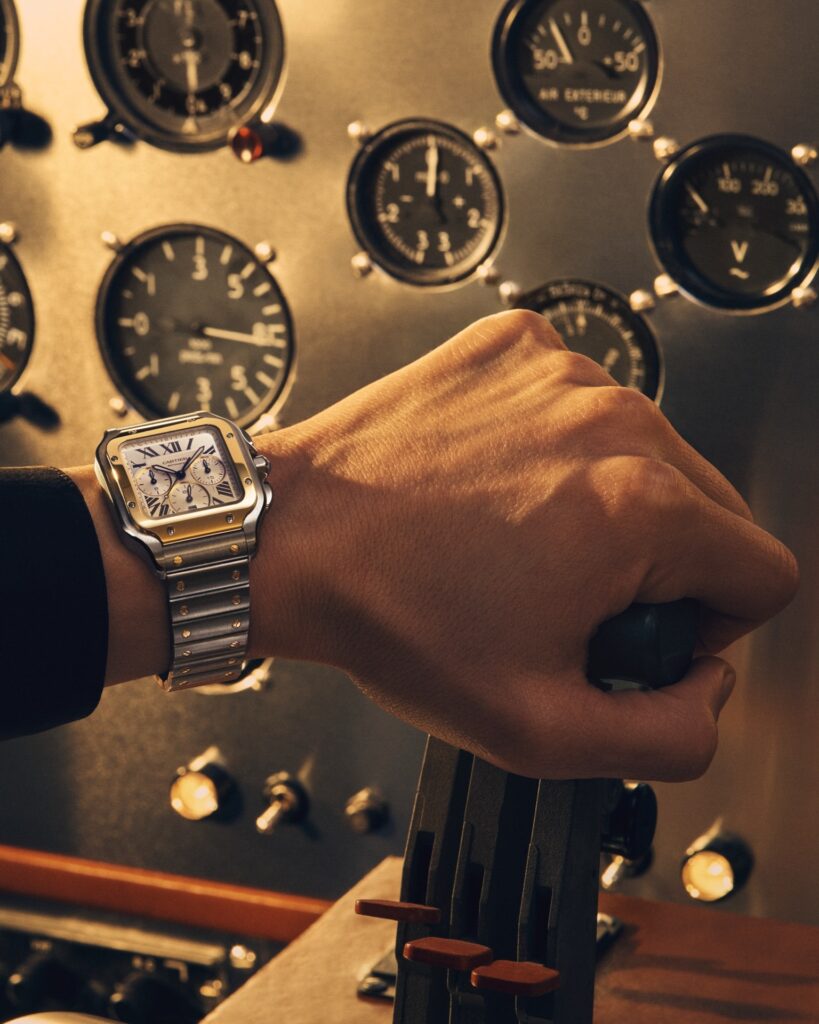
Cartier’s 2026 Santos collection brings six new references to one of watchmaking’s defining square-case designs, split between a more technical Santos de Cartier Chronograph trio and a slimmer, dressier Santos-Dumont family in precious metals.
The release works because it does not treat the Santos as a single idea, but as a platform with two distinct personalities.
Three Santos de Cartier Chronographs Built Around Calibre 1904-CH MC
The Santos de Cartier Chronograph models are powered by Cartier’s in-house calibre 1904-CH MC, made at the brand’s La Chaux-de-Fonds manufacture.

It is a properly specified automatic chronograph movement with a column wheel, vertical clutch and linear reset hammer, a combination intended to deliver clean pusher feel, smooth engagement and consistent reset action.
The movement runs at 28,800 vibrations per hour, uses 35 jewels and offers a 47-hour power reserve, with Côtes de Genève on the bridges and circular graining on the main plate visible through the sapphire caseback.
The chronograph layout places running seconds at 6 o’clock, elapsed minutes at 3 o’clock and elapsed hours at 9 o’clock, keeping the dial balanced within the Santos case geometry.
Steel, Two-Tone and Yellow Gold Give the Chronograph Three Moods
The stainless steel Santos de Cartier Chronograph opens the range with a silvered dial that combines a satin-finished centre with a sunray outer section.
Its rhodium-flashed sub-dial rings, black sword-shaped hands and Super-LumiNova treatment give it the most direct sports-watch character of the three.
The case measures 47.5 mm by 39.8 mm and 11.6 mm thick, with 10 bar of water resistance, a heptagonal crown set with a synthetic blue spinel and Cartier’s familiar exposed bezel screws.
It is priced at EUR 12,000 and comes with both the SmartLink bracelet system for tool-free sizing and QuickSwitch for fast strap changes, including a black rubber strap in the set.
The steel and yellow gold version keeps the same dimensions and dial architecture, but introduces yellow gold on the bezel, crown and bracelet screws, along with gold-flashed counter rings.
At EUR 15,000, it is the warmer and more formal take on the chronograph while retaining the practical bracelet and rubber strap configuration.
The full 18k yellow gold model moves the chronograph firmly into statement territory, pairing the gold case and bracelet with yellow gold dial accents and a natural blue sapphire cabochon in the crown rather than synthetic spinel.
Cartier also includes a semi-matt dark grey alligator strap, making the EUR 60,000 version the most versatile for collectors who want the Santos chronograph to move between bracelet-driven presence and evening-wear refinement.
The Santos-Dumont Stays Slim With a Hand-Wound Movement
The 2026 Santos-Dumont references take the opposite route, using the hand-wound calibre 430 MC to preserve the line’s thin, elegant profile.
Each model measures 43.5 mm by 31.4 mm and just 7.3 mm thick, with 3 bar of water resistance.
The manual movement suits the Santos-Dumont particularly well, not only because it keeps the case slim, but because it gives the watch a more intimate rhythm than the automatic chronograph models.
Obsidian, Gold and Platinum Define the Dress-Watch Side
The standout Santos-Dumont is the yellow gold model with a gilded obsidian dial cut from volcanic stone from Mexico.
At only 0.3 mm thick, the dial is an unusually delicate component, with natural iridescence created by tiny air bubbles trapped in the stone during formation.
That means each dial carries its own variation in depth and light, a quality that gives the watch more character than a conventional decorative finish.
The yellow gold case is paired with a new flexible bracelet made from 394 individual links arranged across 15 rows, with each link measuring just 1.15 mm thick.
A second yellow gold Santos-Dumont replaces the obsidian with a silvered satin sunray dial, offering a cleaner and more adaptable precious-metal version with the same hand-wound movement and flexible bracelet construction.
The platinum Santos-Dumont also uses a silvered satin sunray dial, but its 950 platinum case and bracelet give the design a cooler, denser and more reserved presence.
Cartier has not yet listed public pricing for the silver-dial yellow gold and platinum Santos-Dumont references.
Aviation Origins, Modern Execution
The Santos remains inseparable from Alberto Santos-Dumont, whose need for a watch readable in flight led Louis Cartier to create one of the earliest modern wristwatches.
More than a century later, the square case, Roman numerals, visible screws and blue cabochon still carry that original identity without needing heavy reinterpretation.
For 2026, Cartier has made the split especially clear: the Santos de Cartier Chronograph is the technically assertive option, while the Santos-Dumont is the slimmer and more ceremonial expression of the same design language.
Collectors looking for daily usability will likely gravitate toward the steel or two-tone chronographs, while the obsidian, gold and platinum Santos-Dumont models speak more directly to those who value material nuance, case thinness and the ritual of a manually wound Cartier.