Space-watch history is usually told through the Omega Speedmaster, but Breitling has its own claim staked far beyond the atmosphere.
The Navitimer Cosmonaute was created for astronaut Scott Carpenter in 1962, and more than six decades later the line has returned to orbit in a particularly fitting form.
During NASA’s Artemis II mission, the crew wore their issued Omega X-33 watches, but footage from inside Orion also revealed a new Breitling on board.
At a glance
- Breitling’s Navitimer Cosmonaute has returned to space on the wrists of the Artemis II crew.
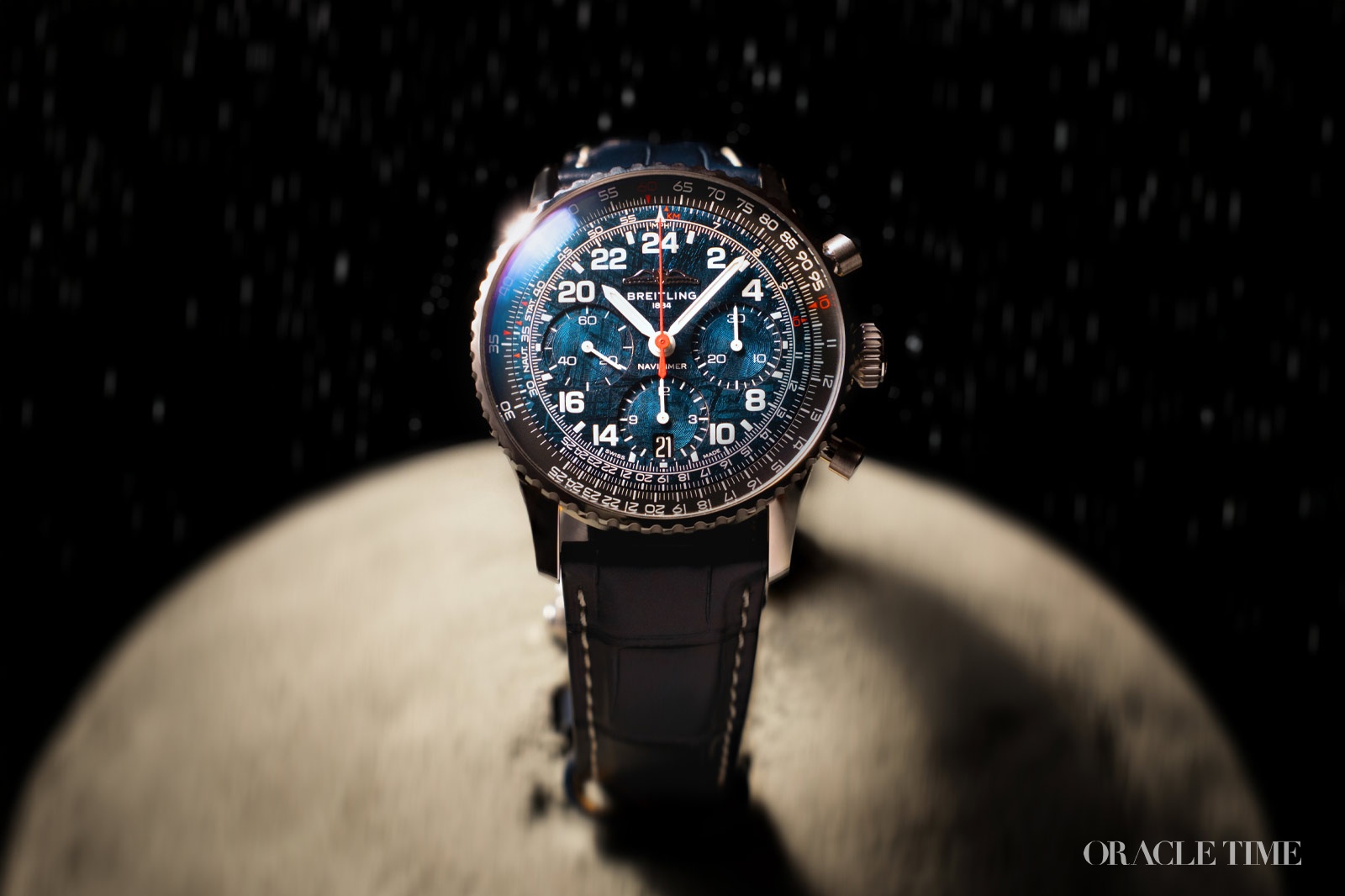
- The new Navitimer B02 Chronograph 41 Cosmonaute Artemis II uses a blue meteorite dial and a 24-hour display.
- The model connects directly to Scott Carpenter’s 1962 Mercury flight, when the Cosmonaute became the first Swiss wristwatch in space.
The 24-hour Navitimer that made orbit
The Cosmonaute story begins with Mercury-Atlas 7, better known as Aurora 7, which launched on 24 May 1962 with Scott Carpenter aboard.
Carpenter was a U.S. Navy test pilot and already knew the Breitling Navitimer, whose slide-rule bezel had become a practical tool for aviators.
For orbital flight, however, he needed something more specific than a standard pilot’s chronograph.

With multiple sunrises and sunsets occurring within a single day in orbit, a conventional 12-hour dial could become less intuitive, so Breitling adapted the Navitimer with a 24-hour display.
The result was the Cosmonaute, with an hour hand making one full circuit per day rather than two.
Carpenter’s flight lasted four hours, 56 minutes and five seconds, completing three orbits of Earth and putting Breitling into space before the Moon-watch era had even begun.

The landing was less tidy than the watchmaking.
Aurora 7 splashed down far from its intended recovery area, leaving Carpenter in the ocean for around three hours before pickup, during which seawater damaged his Cosmonaute.
Breitling replaced the watch, kept the corroded prototype in its archives, and developed the Cosmonaute into a production model.

The early reference 809 remains one of the more attainable links to the first generation of space-era wristwatches, with good examples still found below the level of many better-known space chronographs.
A lineage astronauts kept choosing
The Cosmonaute never became NASA’s issued watch in the way Omega did, but that distinction is part of its appeal.
It lived as a personal choice among pilots and astronauts, a watch that carried the logic of cockpit timing into orbit without losing its Navitimer identity.
In 1996, Claudie André-Deshays, the first French woman in space, wore a Cosmonaute on one wrist and a Breitling Aerospace on the other.
Robert Hines wore a Navitimer B-1 on his way to the International Space Station in 2022.
Polish ESA astronaut Sławosz Uznański-Wiśniewski also wore a 24-hour Navitimer during a 20-day spaceflight in 2025.

The watch also had admirers among spaceflight veterans on the ground, including John Glenn and James McDivitt, both of whom were connected with Cosmonaute models.
That continuing thread matters because the Cosmonaute isn’t simply a commemorative design with a space-themed dial.
Its defining feature, the 24-hour display, came from a practical request made by an astronaut at the dawn of crewed orbital flight.

A blue meteorite Cosmonaute for Artemis II
Artemis II put the Cosmonaute back in view during one of NASA’s most significant crewed missions since Apollo.
The Orion spacecraft launched on 1 April 2026 and splashed down in the Pacific on 10 April at 8:07pm ET, with astronauts Reid Wiseman, Victor Glover, Christina Koch and Jeremy Hansen recovered by Navy divers from the USS John P. Murtha.
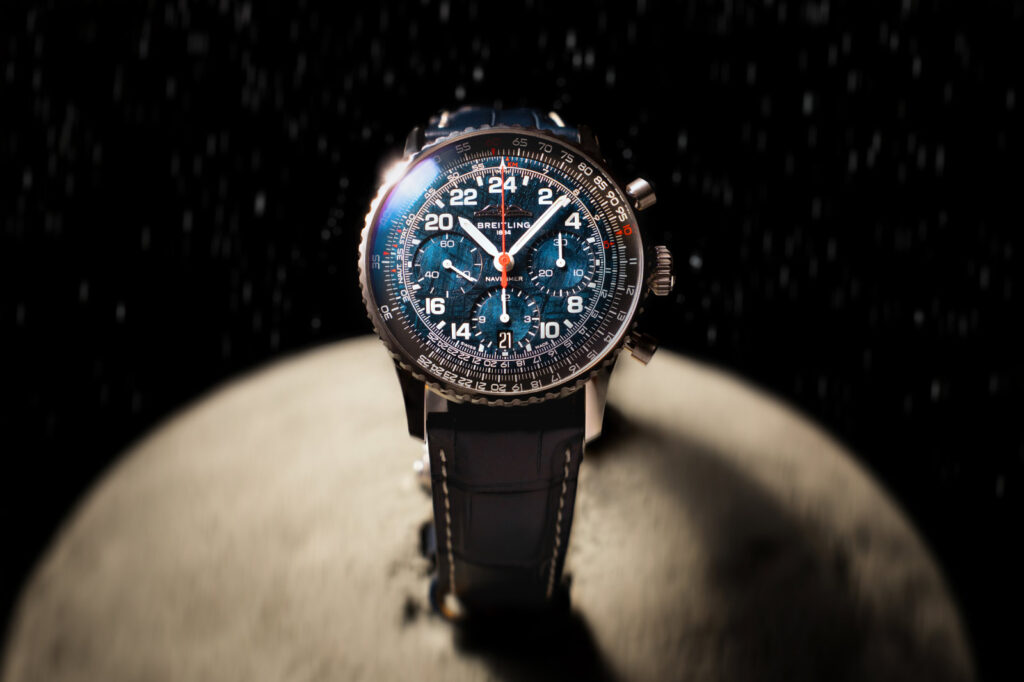
Inside Orion, the crew’s official NASA watches were joined by an unreleased Breitling with the familiar Cosmonaute case profile and a blue dial.

That watch is now identifiable as the Breitling Navitimer B02 Chronograph 41 Cosmonaute Artemis II.
At its core, it remains a 41mm Navitimer in stainless steel, complete with the notched slide-rule bezel that has long defined the collection.
The practical water-resistance rating is 30 metres, a detail that feels almost wry given what happened to Carpenter’s original watch after splashdown.
The defining visual move is the dial, which is made from blue meteorite.
Its Widmanstätten pattern, formed by iron-nickel alloys cooling over immense stretches of time, gives the watch a texture that belongs to the wider cosmos without feeling like a novelty graphic.
Inside is Breitling’s calibre B02, a column-wheel chronograph movement with a 66-hour power reserve and a 4Hz frequency.

It is COSC-certified, with chronometer testing to a tolerance of -4 to +6 seconds per day.
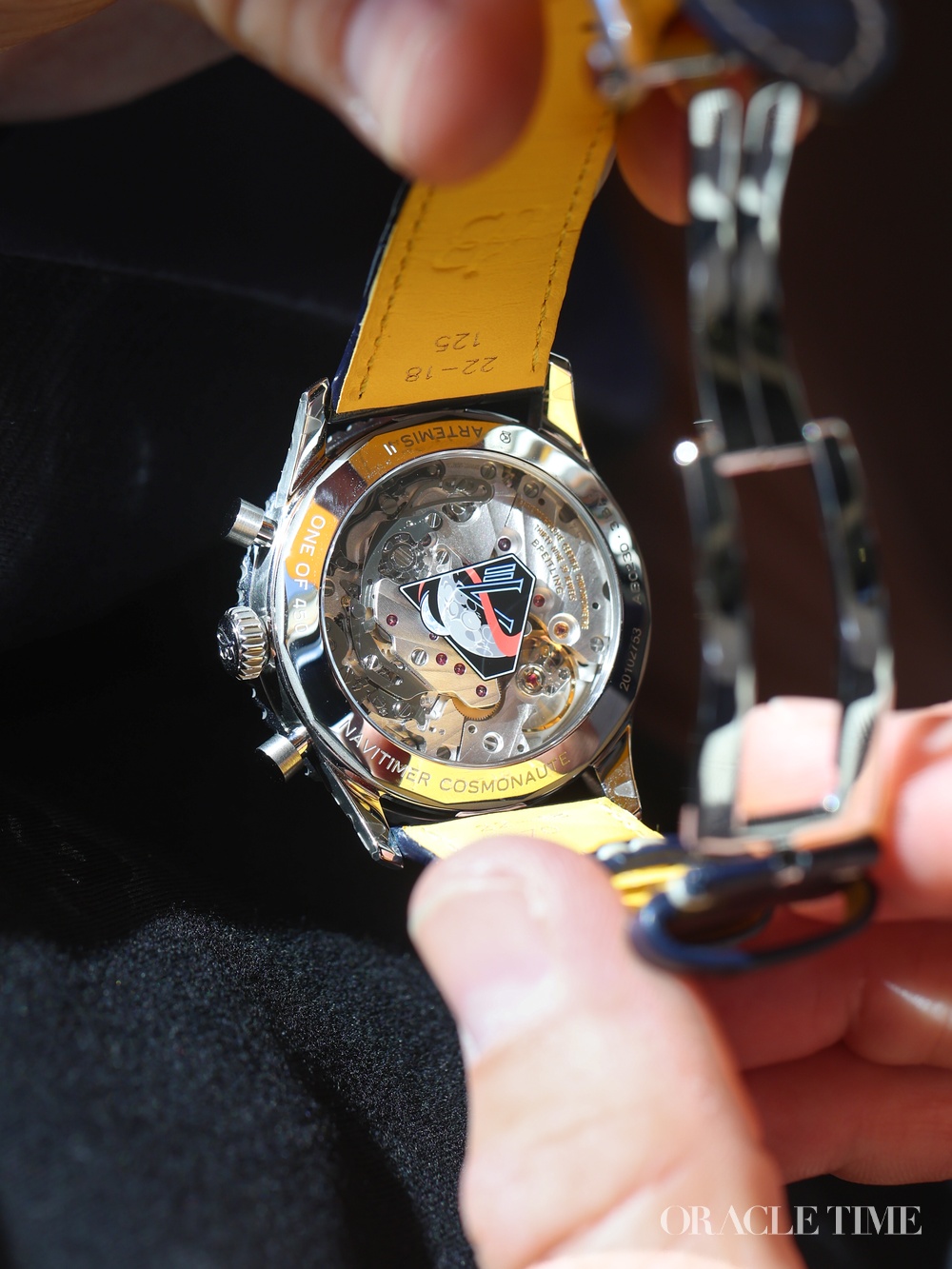
The movement is visible through a sapphire caseback, where the Artemis II mission logo appears on the rear crystal.
That combination of a 24-hour dial, a mechanical chronograph and a meteorite face gives this Cosmonaute a directness that many themed space watches miss.
Details & Specifications
| Brand | Breitling |
|---|---|
| Model | Navitimer B02 Chronograph 41 Cosmonaute Artemis II |
| Case size | 41mm |
| Case material | Stainless steel |
| Dial | Blue meteorite with 24-hour display |
| Movement | Breitling calibre B02 |
| Chronograph | Column-wheel chronograph |
| Frequency | 4Hz |
| Power reserve | 66 hours |
| Certification | COSC chronometer, tested to -4 to +6 seconds per day |
| Water resistance | 30 metres |
| Caseback | Sapphire crystal with Artemis II mission logo |
The Navitimer Cosmonaute has always been a specialist’s watch, built around a functional quirk that came from a real mission requirement.
With Artemis II, Breitling has found a way to honour that past without freezing it in nostalgia, and the blue meteorite dial gives the modern Cosmonaute a material connection to the story it’s telling.