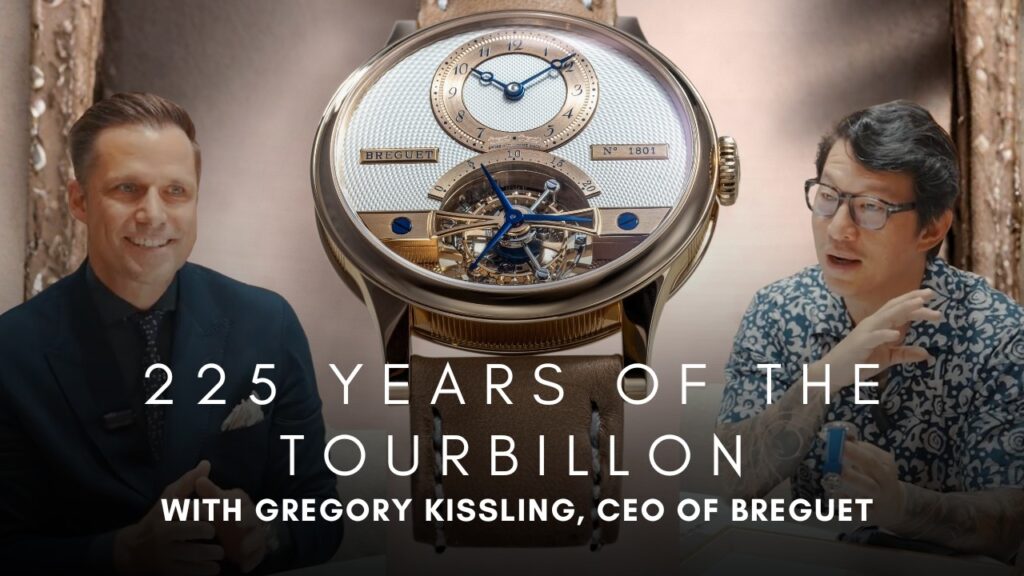
Breguet doesn’t need to borrow significance for the tourbillon.
Abraham-Louis Breguet patented the mechanism in 1801, and 225 years later the manufacture is treating that legacy as a living design brief rather than a museum label.
The result is a quartet of anniversary watches that use the tourbillon to explore different sides of the house, from classical restraint to open architecture and nautical complication.
At a glance
- Breguet is marking 225 years since the tourbillon patent with four new anniversary creations.
- The lineup includes the Classique Tourbillon 7357, Classique Tourbillon Sidéral 7255, Tradition Tourbillon 7047 and Marine Tourbillon Équation Marchante 5887.
- The anniversary focuses on evolution rather than nostalgia, with flying tourbillons, historic mechanisms and contemporary materials all part of the conversation.
A patent that still defines Breguet
The tourbillon is one of watchmaking’s most quoted inventions, but for Breguet it remains unusually personal.
It was conceived by the founder himself as a response to the chronometric challenges of pocket watches, placing the regulating organ in a rotating cage to average out positional errors.
Modern wristwatches have changed the practical context, yet the tourbillon’s symbolic weight has only grown.
For a manufacture with Breguet’s history, the challenge is not proving ownership of the idea, but showing that the idea can still generate new watchmaking.
Four watches, four readings of the tourbillon
The anniversary group is deliberately broad, touching three major Breguet families rather than isolating the celebration in one limited aesthetic lane.
The Classique Tourbillon 7357 sits closest to the brand’s formal dress-watch language, where restraint and proportion do much of the work.
The Classique Tourbillon Sidéral 7255 pushes the same collection into a more visually experimental place, with the flying tourbillon becoming a central statement rather than a quiet technical flourish.
The Tradition Tourbillon 7047 turns the mechanism outward, using the collection’s exposed construction to make the watch feel closer to a piece of horological architecture.
The Marine Tourbillon Équation Marchante 5887 brings the tourbillon into Breguet’s seafaring line, pairing it with a historically rooted astronomical complication and a more contemporary material attitude.
Gregory Kissling’s balance of history and invention
Breguet CEO Gregory Kissling’s position around the anniversary is clear in spirit.
Looking back matters, but simply remaking the past is not enough for a house whose most famous contribution was itself an act of invention.
That tension is visible across the four pieces.
There is revival in the return to an important modern Breguet reference, but there is also a willingness to test the tourbillon through different visual languages and technical contexts.
Flying tourbillons, historic mechanisms and contemporary materials are not treated as competing ideas here.
They become different ways of asking what a Breguet tourbillon should be in the present.
Details & Specifications
| Brand | Breguet |
|---|---|
| Anniversary | 225 years since Abraham-Louis Breguet patented the tourbillon in 1801 |
| Models | Classique Tourbillon 7357, Classique Tourbillon Sidéral 7255, Tradition Tourbillon 7047, Marine Tourbillon Équation Marchante 5887 |
| Primary complication | Tourbillon |
| Collections represented | Classique, Tradition and Marine |
| Key themes | Flying tourbillons, historic mechanisms, revived modern references and contemporary materials |
What makes the anniversary compelling is that Breguet has avoided reducing the tourbillon to a single commemorative object.
Instead, the four watches show how one invention can carry different moods, different histories and different levels of technical expression while still remaining unmistakably tied to the name on the dial.