Blancpain’s latest Villeret is a serious piece of chronometry dressed in transparency.
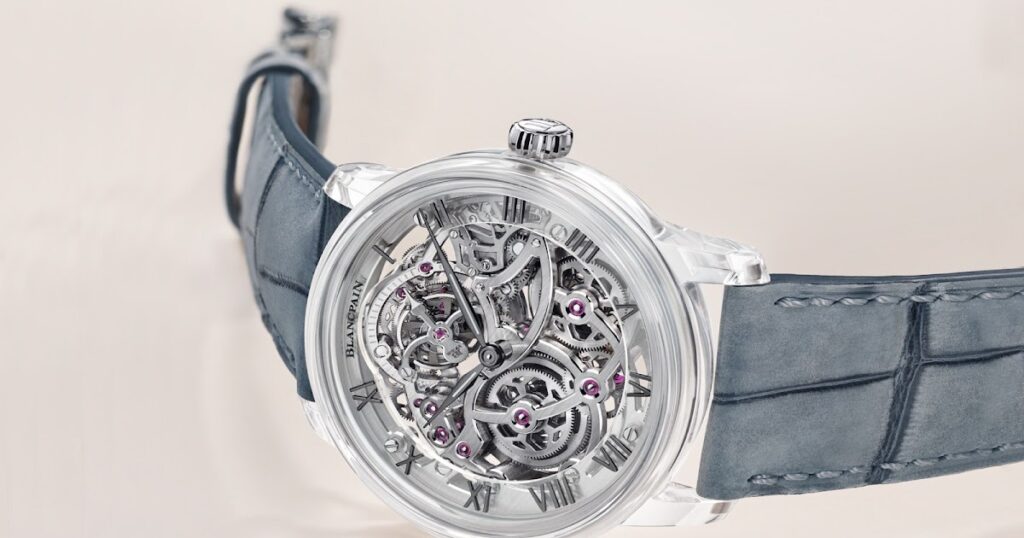
The Villeret Carrousel Incliné introduces a newly developed hand-wound movement with a 30-degree inclined flying carrousel, then places it inside the manufacture’s first full sapphire case.
It’s a watch built around an old idea that Blancpain has made distinctly current, with the regulating organ designed to keep changing its relationship to gravity even when the watch is resting flat.

At a glance
- Blancpain has unveiled the Villeret Carrousel Incliné with a new 30-degree inclined flying carrousel.
- The hand-wound Calibre 222ISQ offers a 100-hour power reserve and is housed in Blancpain’s first full sapphire case.
- The watch is priced at CHF 380,000 or €454,250 and is offered with either rhodium-plated 5N gold or 5N red gold movement architecture.
A tilted carrousel built for positional stability
The carrousel has been part of Blancpain’s modern high-complication language since 2008, when the Le Brassus manufacture brought the mechanism back to the wristwatch more than a century after Bahne Bonniksen invented it in 1892.
Like a tourbillon, a carrousel is intended to average out rate errors caused by gravity, but it gets there through a different mechanical route.
In a tourbillon, a single gear train links the mainspring barrel to the escapement while the cage rotates around a fixed fourth wheel.

In a carrousel, two gear trains connect the barrel to the rotating assembly, with one feeding the escapement and the other independently controlling the cage rotation.
That distinction matters here because Blancpain hasn’t simply angled an existing visual signature.
The new hand-wound Manufacture Calibre 222ISQ was developed over four years and built around a one-minute flying carrousel mounted at 30 degrees relative to the openworked mainplate.

Blancpain says preliminary work used modified demonstrators with inclinations from 0 to 35 degrees in five-degree steps, tested across six standard positions.
The manufacture selected 30 degrees as the compromise between rate stability across positions, movement thinness and visual balance.
The practical aim is simple to understand, even if the mechanics aren’t.

A flat carrousel rotates parallel to the mainplate and can average vertical positional errors while the watch is worn, but it remains in a single horizontal plane when the watch is left dial-up or dial-down.
By inclining the cage, the balance continues to move through changing orientations relative to gravity even when the watch is on a nightstand.
The engineering behind the angle
Delivering energy cleanly to a regulating organ working on a tilted axis required a new carrousel architecture rather than a small adjustment to the old one.

Instead of forcing the full 30-degree change through one gear mesh, Calibre 222ISQ divides the transition into two angled engagements of 22 degrees and 8 degrees before the split into the carrousel’s two drive trains.
The rotating cage has also been reworked.
Blancpain reduced total cage mass by 8.5 percent and lowered rotational inertia by 30 percent, while enlarging the centrally positioned balance wheel to 8 mm without increasing balance inertia.

The balance beats at 4 Hz, or 28,800 vibrations per hour, and uses inset adjustment screws with a silicon hairspring.
To keep the inclined assembly compact, the cage wheel is reduced to 9 mm while preserving existing gear ratios.
A patented double ball-bearing support helps lower the height of the cage and removes the need for bridges that would otherwise block the view of the fourth-wheel pinion engagement and the cage-rotation gear train.

There’s also a three-arm cannon-pinion friction system to save radial space while allowing hand setting.
The beak-shaped seconds indicator, a form more commonly associated with tourbillon architecture, tilts slightly downward to maintain clearance under the crystal.
The movement is made of 224 components and 37 jewels, with hours, minutes and seconds shown on the dial side.

Two series-coupled mainspring barrels provide a guaranteed 100-hour power reserve, with the barrels designed to deliver a flatter torque curve.
Openworked barrel drums reveal the mainsprings directly, while a graphical power-reserve display marked from “E” to “F” is integrated into the barrel that supplies the going train.
Each watch is tested in all six positions across the full 100-hour power reserve and delivered with an individual Blancpain chronometry certificate guaranteeing an average daily rate tolerance of 0 to +2 seconds per day.

A sapphire case with no hidden surfaces
The Villeret Carrousel Incliné is also the first Blancpain watch to use a full sapphire case.
The case is made in La Chaux-de-Fonds from sapphire grown using the Kyropoulos process.
Its construction uses two main components, with an integrated case middle and back paired with an integrated bezel and crystal.

Each of those two sapphire elements requires around 100 hours of machining and polishing.
Despite the movement’s architectural complexity, the finished watch remains within wearable proportions.
The case measures 40.30 mm across, 11.30 mm thick and 46.45 mm lug-to-lug, with a 22 mm lug width and 3 bar of water resistance.

The sapphire dial keeps the view open while adding enough structure to read the watch.
It carries bevelled, applied baton-style indexes in polished black gold, paired with leaf-shaped hands filled with white Super-LumiNova that glows blue in the dark.
Finishing treated as two front sides
The transparent case and ultra-skeletonised construction leave Blancpain’s decorators with nowhere to hide.

The manufacture treats Calibre 222ISQ as having two upper sides rather than a conventional dial side and back.
Each movement requires 210 hours of hand finishing, supported by more than 60 custom-made tools.
The mainplate or barrel bridge alone takes 55 to 60 hours, while the carrousel bridge requires one and a half weeks of work.
Both upper and lower surfaces receive anglage, with a broader 30-degree angle on top and 45 degrees underneath.
Across the movement, artisans hand-shape and polish 253 sharp inward angles using burins, abrasive papers on wooden sticks and final polishing with wild gentian stems harvested in the Vallée de Joux.
The movement also incorporates perlage and straight-grained satin brushing.
Each watch is assembled from start to finish by a single master watchmaker.
Details & Specifications
| Brand | Blancpain |
|---|---|
| Model | Villeret Carrousel Incliné |
| References | 66222S 0000 55B and 66222S A 0000 55B |
| Case size | 40.30 mm diameter, 11.30 mm thickness, 46.45 mm lug-to-lug |
| Case material | Full sapphire case |
| Lug width | 22 mm |
| Water resistance | 3 bar, 30 metres or 100 feet |
| Dial | Sapphire dial with polished black gold indexes and leaf-shaped Super-LumiNova hands |
| Movement | Hand-wound Manufacture Calibre 222ISQ |
| Movement material | 18-carat movement in rhodium-plated 5N gold or 5N red gold |
| Complication | One-minute flying carrousel inclined at 30 degrees |
| Frequency | 4 Hz, 28,800 vibrations per hour |
| Power reserve | Guaranteed 100 hours |
| Components | 224 components and 37 jewels |
| Functions | Hours, minutes, seconds and power-reserve indication |
| Strap | Interchangeable glazed blue-grey alligator leather strap |
| Clasp | Matching 18-carat gold folding clasp with safety system |
| Price | CHF 380,000 or €454,250 |
For collectors drawn to visible mechanics, the Villeret Carrousel Incliné is less about spectacle for its own sake than about showing the logic of a difficult chronometric solution from every side.
It’s a Blancpain for those who care about the difference between a tourbillon and a carrousel, and who want that distinction made legible in sapphire, gold and painstaking hand work.