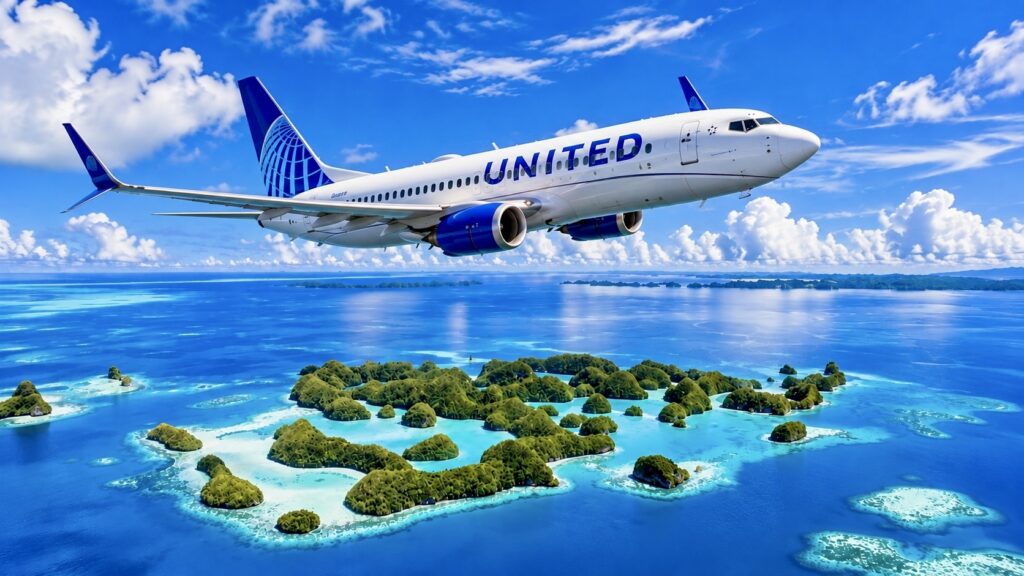
United Airlines’ route between Palau and Tokyo Narita is the sort of flight that reminds you aviation isn’t only about flagship suites and glossy hub lounges.
It sits inside one of the more unusual airline networks in the Pacific, linking remote island destinations through Guam and connecting places that many long-haul travellers barely notice on the map.
The Boeing 737-800 Business Class product used on this journey was dated, but the route itself carried real interest for anyone drawn to remote aviation, island travel and the less familiar edges of a global airline network.

At a glance
- United’s Palau to Tokyo Narita service offered a rare look at the airline’s Guam-centred Pacific network.
- The Boeing 737-800 used on this flight had a 16-seat Business Class cabin with conventional recliner seats rather than lie-flat beds.
- United has since moved the route to the Boeing 737 MAX, so current passengers may encounter a newer cabin.
A Pacific route with more intrigue than glamour
The flight ran from Palau International Airport, officially Roman Tmetuchl International Airport, to Tokyo Narita International Airport.
It departed on time at 11:30 am and arrived on time at 4:30 pm, covering 1,979 miles, or 3,185 kilometres, in 4 hours and 30 minutes.
The aircraft was a Boeing 737-800 Next Generation, the narrow-body type that has long formed the backbone of United’s domestic and regional operations.

On this route, though, the aircraft was doing something more distinctive than a routine mainland hop.
United’s Pacific network is centred on Guam, a US territory in Micronesia that functions as the airline’s regional hub for island services and connections into Asia.
That network traces its roots to Continental Airlines and Continental Micronesia, whose operations were integrated into United after the 2010 merger.

Today, United links Guam with destinations including Palau, the Federated States of Micronesia and the Marshall Islands, along with major cities in Asia.
The network matters because the distances are vast, the island populations are relatively small and alternative air links can be limited.
Its most famous expression is the Island Hopper, a scheduled service between Guam and Honolulu that calls at several points across Micronesia and the Marshall Islands depending on direction and schedule, including Majuro, Kwajalein, Kosrae, Pohnpei and Chuuk.

The fare story was almost as unusual as the route
Pricing on the Palau to Tokyo route can be striking.
For this journey, the advertised one-way Business Class fare was more than US$3,000 for an approximately four-hour flight on a narrow-body aircraft with recliner seating.
An Economy Class ticket was booked instead for US$1,575 one way, which was still a substantial fare for the length of the flight.

After booking, United offered an upgrade to Business Class for US$250, changing the value equation considerably.
That kind of offer should never be assumed, since upgrade pricing depends on inventory, demand and airline revenue management.
Still, it illustrates the particular tension of this route, where limited competition and remote geography can produce fares that feel disconnected from the onboard hardware.

Inside the older Boeing 737-800 Business Class cabin
The Business Class cabin on this Boeing 737-800 had four rows in a 2-2 layout, making 16 seats in total.
That configuration eliminated the middle seat found in Economy’s 3-3 layout and gave each passenger more width, but it didn’t deliver the privacy associated with newer premium narrow-body products.
For couples, the paired seats were practical.

For solo travellers, every seat still came with a neighbour.
The seat itself measured 20.4 inches, or 52 centimetres, wide, with 38 inches, or 97 centimetres, of pitch.
It reclined to a comfortable angle but did not convert into a flat bed.

Controls were positioned in the centre armrest, while the tray table folded out from the armrest on the window or aisle side.
Power outlets were placed low in the shared armrest area, making them less convenient to find and use.
The overall impression was of an earlier generation of premium travel, acceptable for a daytime regional flight but hard to reconcile with a fare above US$3,000.

Service lifted an otherwise dated experience
The soft product was simple.
Business Class passengers received a basic amenity set with earplugs, an eye mask and a dental kit, along with a blanket.
Lunch was served on one tray and included salad, beef with mashed potatoes and cheesecake for dessert.

It followed a standard airline meal format rather than anything especially elaborate.
The strongest part of the flight was the cabin crew, who were described as warm, approachable and notably friendly throughout the journey.
That mattered on an aircraft where the hard product was clearly showing its age.

Entertainment was less convincing.
Each Business Class seat had a small personal screen in the seatback ahead, but it was not touchscreen-enabled and had to be controlled through a separate panel in the armrest.
The content selection was limited, and Wi-Fi was not available on this flight.

A newer aircraft is now part of the story
United has since changed the aircraft on the Palau to Tokyo route to the Boeing 737 MAX as part of a broader renewal of its Guam-based fleet.
The airline is replacing its Boeing 737-800s in the region with ten Boeing 737 MAX 8 aircraft, with the transition scheduled for completion by the end of 2026.
The newer aircraft introduce seatback entertainment screens at every seat, larger overhead bins, Wi-Fi available for purchase, Bluetooth connectivity, LED lighting, more extra-legroom seating and a brighter cabin interior.
The Boeing 737 MAX 8 is also set to operate the Island Hopper service, bringing the refreshed aircraft to one of United’s most distinctive Pacific routes.
Aircraft assignments can vary by schedule, but travellers flying between Palau and Tokyo today may find a more contemporary onboard environment than the Boeing 737-800 cabin described here.
Details & Specifications
| Airline | United Airlines |
|---|---|
| Route | Palau International Airport (ROR) to Tokyo Narita International Airport (NRT) |
| Aircraft flown | Boeing 737-800 Next Generation |
| Current aircraft noted for route | Boeing 737 MAX |
| Class | Business Class |
| Seat | 4A |
| Business Class layout | 2-2 |
| Business Class capacity | 16 seats |
| Seat width | 20.4 inches / 52 cm |
| Seat pitch | 38 inches / 97 cm |
| Distance | 1,979 miles / 3,185 km |
| Flight time | 4 hours 30 minutes |
| Departure | 11:30 am, on time |
| Arrival | 4:30 pm, on time |
| Wi-Fi on this flight | Not offered |
| Observed Business Class fare | More than US$3,000 one way |
| Observed Economy fare | US$1,575 one way |
| Observed upgrade offer | US$250 |
As a premium cabin experience, this Palau to Tokyo flight was limited by its ageing seat, basic entertainment and modest meal service.
As a window into United’s Pacific operation, it was far more compelling, especially now that the route sits within a fleet renewal that should make this remote corner of the network more comfortable to fly.