Alaska rewards travellers who are willing to give the map some space.
Its greatest moments often happen outdoors, where glaciers crack into the sea, whales surface beside quiet coves and mountains seem to take over the horizon.
Whether you’re arriving by cruise ship, driving south from Anchorage or flying into deeper wilderness, these ten experiences capture the range and scale of the Last Frontier.

At a glance
- Alaska’s must-do experiences span glaciers, wildlife, scenic roads, rainforest, national parks and winter aurora viewing.
- Standout moments include Glacier Bay, Kenai Fjords, Denali, Katmai’s brown bears and the Seward Highway.
- The right trip depends heavily on season, with summer favouring wildlife and cruising while winter opens the door to Northern Lights viewing.
Southeast Alaska by forest and sea
For many travellers, Alaska begins in the island-dotted waterways of the southeast.
This is cruise country, but the best experiences go well beyond the view from the deck.
10. Explore the Tongass National Forest near Ketchikan

Ketchikan is the gateway to the Tongass National Forest, the largest national forest in the United States and one of the world’s great temperate rainforests.
Beyond the harbour, the landscape quickly turns into mossy forest, steep mountains, clear waterways and the kind of green silence that makes Southeast Alaska feel distinct.
One of the more active ways to see it is on an Adventure Kart Expedition with Kawanti Adventures, which heads into the backcountry on improved forest trails in a Polaris RZR.

The guided outing lasts around 1.5 hours and climbs into the mountains for views over the forest, Behm Canal and the Inside Passage.
Drivers and passengers can switch positions during the experience, which gives it a more hands-on feel than a standard sightseeing tour.
Wildlife is never guaranteed, but eagles, deer and even bears are part of the wider Tongass environment.

9. Cruise the Inside Passage
The Inside Passage remains one of Alaska’s classic journeys because it links scenery, wildlife and coastal culture in a way that feels effortless.
The route winds through sheltered channels lined with rainforest, mountain slopes and small communities that are often easier to reach by water than by road.

It’s also one of the most accessible ways to see humpback whales, orcas, bald eagles and glacier-shaped coastlines in a single trip.
For first-time visitors, the Inside Passage offers a strong introduction to Alaska without losing the sense of scale that makes the state so compelling.
Glaciers, fjords and the coastal road south
Alaska’s southern coast is where ice, ocean and mountains meet with particular force.

It’s also where travellers can combine national parks, boat journeys and one of America’s great scenic drives.
8. Get away into Kenai Fjords National Park
Near the coastal town of Seward, Kenai Fjords National Park brings together deep fjords, rugged shoreline and tidewater glaciers descending from the Harding Icefield.

Boat trips are the most popular way to experience the park, with the chance to see humpback whales, orcas, sea lions, seals, sea otters and bald eagles.
The drama builds near the glaciers, where blue ice towers above the water and can calve with a sound that rolls across the fjord.
For a quieter encounter, kayaking offers a more intimate way to explore sheltered waterways and rocky coastlines.

Travellers looking for a deeper escape can also stay at the remote Kenai Fjords Glacier Lodge, surrounded by protected wilderness and glacier scenery.
7. Drive the Seward Highway
The Seward Highway connects Anchorage with Seward and turns the journey itself into one of Alaska’s essential experiences.

The route follows Turnagain Arm before pushing through the mountains and wild country of the Chugach region.
Scenery shifts constantly, moving through coastal water views, steep slopes, forest, waterfalls and open valleys.
Wildlife adds another layer, with beluga whales sometimes seen in Turnagain Arm, Dall sheep on rocky cliffs and bald eagles overhead.
For travellers who want to see Alaska away from cruise ports, this drive delivers a strong sense of space without needing a remote expedition.
6. Watch a tidewater glacier calve in Glacier Bay
Glacier Bay National Park and Preserve covers more than three million acres of mountains, glaciers, fjords, temperate rainforest and wild coast.
It also forms part of a UNESCO World Heritage Site, which reflects the global significance of this vast protected landscape.
Cruising through the bay places travellers close to immense ice walls and snow-covered peaks, with the possibility of seeing humpback whales, orcas, sea otters, seals, sea lions and bald eagles along the way.
The most memorable moment is often auditory before it’s visual.
A deep crack rolls across the water, then a section of glacier breaks away and collapses into the sea.
Wildlife encounters worth building a trip around
Alaska’s wildlife isn’t a side attraction.
For many visitors, it’s the reason to come.
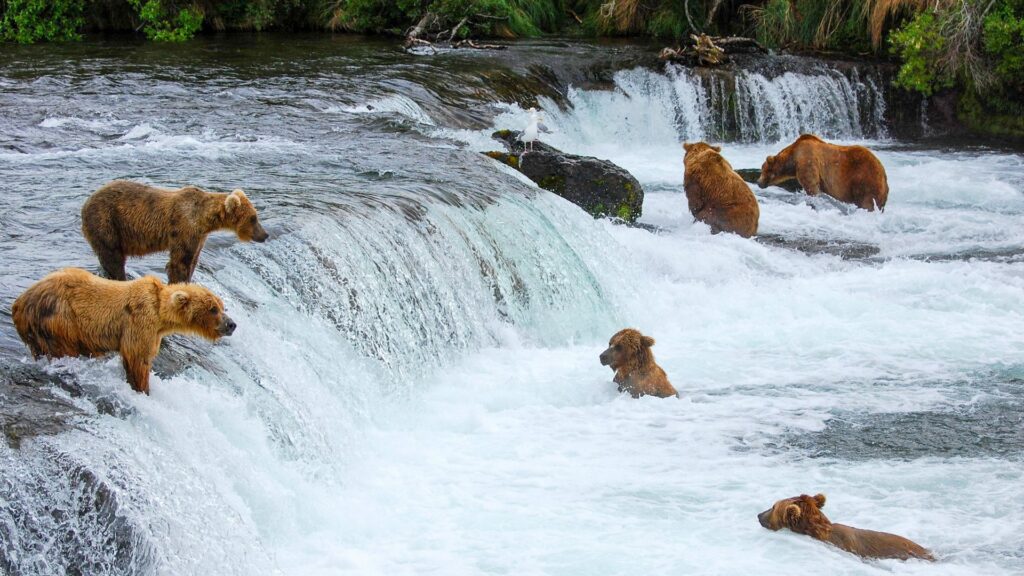
5. Watch brown bears in Katmai National Park
Katmai National Park is one of the most remarkable places in Alaska to see wild brown bears.
The experience is powerful because it places travellers near animals that still dominate their landscape, often with rivers, tundra and remote wilderness setting the stage.
Bear viewing here requires planning and respect for strict safety procedures, but the reward is one of North America’s defining wildlife encounters.
It’s best suited to travellers who want Alaska at its most raw rather than its most convenient.
4. Look for whales and marine life along the coast
Humpback whales and orcas are among Alaska’s most sought-after sightings, and the state’s coastal waters offer some of the best opportunities to look for them.
Whale watching can be part of a cruise, a dedicated boat excursion or a national park trip such as Kenai Fjords or Glacier Bay.
The appeal is not just the animals themselves, but the setting around them.
A breaching whale beneath a glacier-lined horizon is the kind of scene that defines an Alaska journey.
3. Walk the tundra in Denali
Denali brings a different mood to the Alaska experience.
Here the drama comes from broad tundra, immense mountain country and the sense of being far inside the continent rather than along its coast.
The park is anchored by Denali itself, North America’s highest peak, though cloud and weather can make even a glimpse feel earned.
For travellers interested in vast landscapes, alpine ecosystems and wildlife viewed in open country, Denali is a cornerstone of any Alaska wish list.
Winter skies and the pull of the remote north
Summer gets much of the attention in Alaska, but winter changes the state’s rhythm completely.
Cold, darkness and distance become part of the experience rather than obstacles to it.
2. See the Northern Lights in Fairbanks
Fairbanks is one of Alaska’s strongest destinations for aurora viewing, thanks to its inland position and location beneath the auroral oval.
On a clear winter night, the sky can shift into bands of green, purple and sometimes red light.
The prime viewing season generally runs from late August or September through April, with the deepest winter months offering especially dark skies.
The aurora is never guaranteed, so it’s wise to allow several nights and move away from urban glare when possible.
Pairing Northern Lights viewing with cold-weather adventures gives Fairbanks a character quite different from Alaska’s summer cruise ports.
1. Fly into Alaska’s deeper wilderness
Some of Alaska’s most memorable places are not reached by road at all.
Flying into remote country opens up a view of the state that is difficult to grasp any other way, with glaciers, braided rivers, mountains and tundra unfolding beneath the aircraft.
For travellers with the time and budget, this kind of journey can connect the more famous highlights with Alaska’s defining reality.
Its wilderness is not decorative backdrop, but the main event.
Alaska is at its best when a trip leaves room for weather, wildlife and scale to do their work.
Choose a few of these experiences rather than trying to rush them all, and the state has a way of feeling less like a checklist and more like a place that keeps expanding around you.