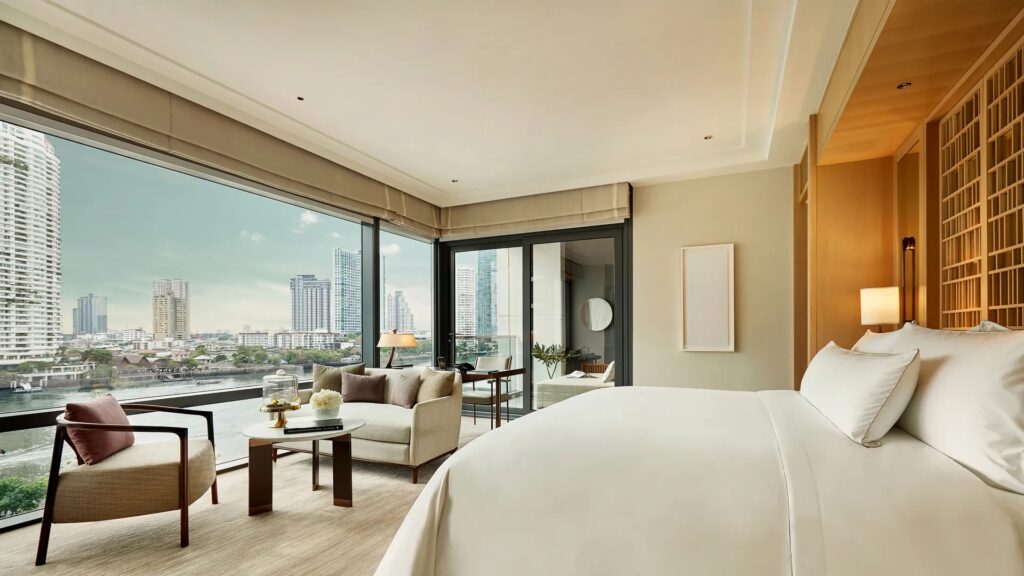
The World’s 50 Best Hotels is now one of luxury travel’s most closely watched annual moments.
The 2026 list puts Rosewood Hong Kong back at number one, with Bangkok and Hong Kong again taking an unusually prominent share of the highest positions.
The result is a ranking full of serious hotels, but also one that feels less like a global shake-up and more like a reaffirmation of a particular luxury-travel consensus.

At a glance
- Rosewood Hong Kong leads The World’s 50 Best Hotels 2026, retaining the number-one position.
- Bangkok places three hotels in the top ten, while Hong Kong has two in the top eight.
- The ranking is voted on by more than 800 travel industry figures and experienced luxury travelers across 13 regions.
The 2026 list
Rosewood Hong Kong sits at the top again, followed by Capella Bangkok, Four Seasons Bangkok at Chao Phraya River, Atlantis The Royal in Dubai and Passalacqua on Lake Como.
The full top 50 spans city hotels, grand European addresses, remote resorts and a handful of newer openings that have quickly entered the conversation.
- 1. Rosewood Hong Kong, Hong Kong
- 2. Capella Bangkok, Bangkok
- 3. Four Seasons Bangkok at Chao Phraya River, Bangkok
- 4. Atlantis The Royal, Dubai
- 5. Passalacqua, Lake Como
- 6. Rosewood São Paulo, São Paulo
- 7. Mandarin Oriental Qianmen, Beijing
- 8. The Upper House, Hong Kong
- 9. Chablé Yucatán, Mexico
- 10. Mandarin Oriental Bangkok, Bangkok
- 11. Aman Tokyo, Tokyo
- 12. Four Seasons Firenze, Florence
- 13. Claridge’s, London
- 14. Hôtel de Crillon, Paris
- 15. Jumeirah Marsa Al Arab, Dubai
- 16. Capella Sydney, Sydney
- 17. Raffles Singapore, Singapore
- 18. Casa Maria Luigia, Modena
- 19. Le Bristol Paris, Paris
- 20. Cheval Blanc Paris, Paris
- 21. Desa Potato Head, Bali
- 22. San Ysidro Ranch, Santa Barbara
- 23. One&Only Mandarina, Riviera Nayarit
- 24. Bulgari Hotel Tokyo, Tokyo
- 25. Las Ventanas al Paraíso, Los Cabos
- 26. Royal Mansour Marrakech, Marrakech
- 27. Four Seasons Hotel Astir Palace, Athens
- 28. Raffles London at The OWO, London
- 29. Copacabana Palace, Rio de Janeiro
- 30. The Taj Mahal Palace, Mumbai
- 31. The Peninsula Istanbul, Istanbul
- 32. Bulgari Hotel Roma, Rome
- 33. Patina Osaka, Osaka
- 34. Mount Nelson, Cape Town
- 35. Nihi Sumba, Sumba
- 36. Badrutt’s Palace, St. Moritz
- 37. Park Hyatt Kyoto, Kyoto
- 38. Hôtel du Couvent, Nice
- 39. Portrait Milano, Milan
- 40. Hôtel de Paris Monte-Carlo, Monaco
- 41. Plaza Athénée, Paris
- 42. Hotel Sacher Vienna, Vienna
- 43. Estelle Manor, Oxfordshire
- 44. Hotel du Cap-Eden-Roc, Antibes
- 45. Amangiri, Utah
- 46. The Peninsula Hong Kong, Hong Kong
- 47. Maroma, Riviera Maya
- 48. Aman Nai Lert Bangkok, Bangkok
- 49. The Connaught, London
- 50. San Domenico Palace, Taormina
The top tier looks very familiar
The most striking thing about the 2026 edition is how little the upper end has changed.
Rosewood Hong Kong remains first, Capella Bangkok and Four Seasons Bangkok are still locked into the top three, and Passalacqua continues to hold a place among the first five.
There’s nothing inherently wrong with consistency.
The best hotels in the world don’t become ordinary because a calendar year has passed, and truly exceptional service cultures are built over time rather than through one-season spectacle.
Still, an annual ranking carries the implication of fresh movement, and this list doesn’t always deliver that sense of renewal.
A hotel sliding a few places isn’t suddenly diminished, just as a property climbing sharply hasn’t necessarily transformed overnight.
Those changes often say as much about voting patterns, recent travel routes and industry visibility as they do about the guest experience inside the property.
Bangkok and Hong Kong crowd the summit
Bangkok’s performance is extraordinary by any measure.
Capella Bangkok is second, Four Seasons Bangkok at Chao Phraya River is third, Mandarin Oriental Bangkok is tenth and Aman Nai Lert Bangkok appears at number 48.
Hong Kong is almost as conspicuous at the top, with Rosewood Hong Kong first, The Upper House eighth and The Peninsula Hong Kong in the top 50.
Both cities deserve serious respect as luxury-hotel destinations.
Bangkok has become a global reference point for high-touch hospitality, while Hong Kong’s best hotels combine polished urban service with architecture, dining and skyline theatre that few cities can match.
The question is one of proportion.
When three Bangkok hotels occupy three of the first ten places in a worldwide ranking, it’s reasonable to ask whether the list is identifying the absolute best hotels on earth or reflecting where influential travelers have been most engaged lately.
The same applies to Hong Kong, where two properties inside the top eight suggests a level of dominance that will feel persuasive to some travelers and overstated to others.
The voting system rewards memory as much as discovery
The ranking is shaped by more than 800 voters across 13 geographical regions, including travel journalists, hoteliers and experienced luxury travelers.
Each voter selects seven hotels they have personally stayed at during the previous three years, then ranks those stays by preference.
That requirement is sensible because it anchors the vote in actual experience rather than reputation alone.
It also means the list can never be a comprehensive assessment of every great hotel operating at that moment.
Hotels in destinations with stronger travel flows, greater industry attention or easier access for frequent luxury travelers may naturally appear more often in voters’ recent memory.
There also isn’t a universal scoring checklist that places service, design, food, location, wellness, cultural depth and value into a single weighted formula.
That makes the ranking human and subjective, which is part of its appeal.
It also means travelers should read it as a map of taste, momentum and visibility rather than a definitive hierarchy of global hospitality.
For anyone planning a major trip, the 2026 list is still useful.
It highlights hotels with real influence, introduces a few names beyond the usual European grand-hotel circuit and confirms the continuing strength of Asian city hospitality.
But the list is most helpful when treated as a starting point, not a final answer.
Has the ranking lost the plot? Not entirely, but the 2026 edition does make one thing clear: luxury travel’s most celebrated consensus can be impressively polished and surprisingly narrow at the same time.