Sonora Resort is the kind of place that makes arrival feel like a threshold moment.
Set on remote Sonora Island in British Columbia’s Discovery Islands, the Relais & Châteaux property combines coastal wilderness, refined lodge-style hospitality and a sense of distance that’s increasingly rare in high-end travel.
There are no roads leading in, no neighboring town on the doorstep and no urban backdrop competing with the mountains, rainforest and water.

At a glance
- Sonora Resort is a remote Relais & Châteaux wilderness retreat on Sonora Island in British Columbia’s Discovery Islands.
- The experience centers on waterfront lodge living, wildlife, marine excursions, fishing, wellness and fine dining.
- Access is by helicopter, seaplane or water taxi, with the 50-minute helicopter transfer from Vancouver forming part of the appeal.
A private-island setting shaped by water and forest
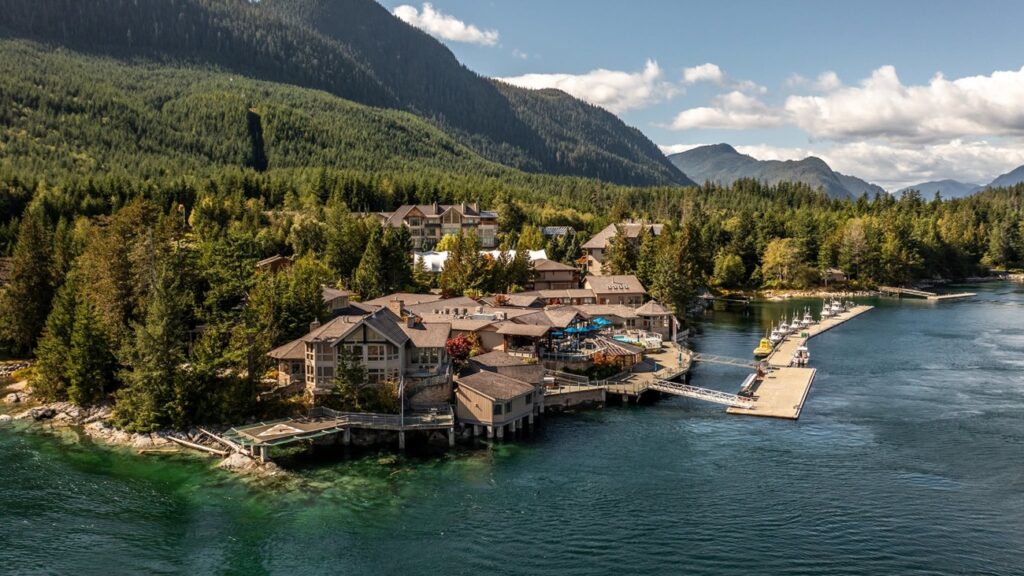
The resort occupies a dramatic waterfront position on the eastern edge of Sonora Island, surrounded by forested slopes, rocky shorelines and the channels of British Columbia’s coast.
It’s a landscape that does much of the talking.
From different points around the property, views open across the water toward neighboring islands and distant snow-capped peaks, while bald eagles, marine life and the surrounding rainforest keep the wilderness close.

That sense of seclusion is central to Sonora’s character.
Even with polished service and substantial facilities, the resort doesn’t feel like it has been dropped onto the island so much as carefully threaded into it.
The absence of road access matters, not just logistically but emotionally.

Once you’re there, the outside world feels meaningfully distant, which is exactly the point.
The arrival is part of the experience
Reaching Sonora Resort is one of the most memorable parts of the stay.
The most convenient route is a helicopter transfer from Vancouver, a flight of roughly 50 minutes operated by London Air Services.

Departures use Skyservice at Vancouver International Airport, a private aviation facility about 10 minutes by taxi from the main terminal.
Guests are typically asked to arrive around an hour before departure, and the experience is far calmer than moving through a conventional airport.
Once airborne, the flight passes over the Gulf Islands and the intricate waterways around Desolation Sound before landing directly at the resort.

It’s less a transfer than an aerial introduction to the geography that defines the stay.
Seaplane transfers from Vancouver may also be possible, depending on guest numbers and weather conditions.
For travelers coming from the United States, Kenmore Air operates scheduled seaplane flights from Kenmore/Lake Washington near Seattle to Sonora, with a journey time of around three hours depending on stops.

A water taxi from Campbell River on Vancouver Island offers another way in.
From fishing lodge to polished wilderness retreat
Sonora’s story began in 1979, when the property operated as a rustic fishing lodge.
That heritage still matters, but it no longer defines the full experience.

The resort changed course in the early 2000s after being acquired by Vancouver’s Louie family, whose business interests include London Drugs and London Air Services.
Brandt Louie had a personal connection to fishing and the British Columbia wilderness, and the property was gradually transformed into something broader and more sophisticated.
The ambition was not simply to make a fishing lodge more comfortable.

Sonora evolved into a destination built around wilderness adventure, fine dining, wellness, high-end accommodation and the kind of service expected from a top-tier retreat.
Fishing remains part of the resort’s identity, but it now sits alongside wildlife viewing, helicopter adventures, spa time and marine exploration.
That mix is what gives the property its appeal to more than one kind of traveler.

Lodge living with a small-village feel
Sonora Resort is arranged less like a conventional hotel and more like a compact West Coast village.
The main lodge forms the social heart of the property, with the restaurant, lounge, boutique, games room and cinema gathered inside.
Beyond it, the resort spreads out through separate pavilions and lodges connected by paths through the grounds.

The spa, conservatory and tennis court each occupy their own buildings, while rooms, suites and villas are distributed across individual lodges rather than stacked into one central structure.
This gives the property a relaxed rhythm.
Guests move between meals, excursions and quiet moments outdoors rather than spending the stay inside a single hotel shell.

Many of the accommodation buildings include shared lounges with fireplaces and large windows, creating informal places to read, linger or watch the weather move across the water.
The terrace in front of the main lodge is one of Sonora’s natural gathering points.
It overlooks the water and leads down toward the private dock, which acts as the launch point for many of the resort’s outdoor experiences.

Wildlife excursions, fishing trips and coastal explorations typically begin here, reinforcing the sense that the dock is not just a facility but the resort’s gateway to the surrounding wilderness.
Who Sonora Resort is really for
Sonora will resonate most with travelers who want comfort without losing contact with the landscape.
It’s not an urban resort with wilderness as decoration, and it’s not a bare-bones adventure lodge with luxury added as an afterthought.
The strongest appeal is for guests who value privacy, nature, water-based exploration and a high level of hospitality in equal measure.
It also suits travelers who enjoy the ceremony of arrival, because getting there is built into the drama of the stay.
Practical planning matters, especially because access depends on air or water transfers and seaplane operations can be affected by weather.
Guests booking through Virtuoso may be able to receive VIP-style benefits, which can add value at a property where the experience is as important as the room itself.
Sonora Resort stands out because it doesn’t try to soften the wilderness into something generic.
It lets the coast, the forest and the journey remain central, while providing enough polish to make the remoteness feel deeply comfortable.