A dress watch doesn’t need gold or a precious-metal case to feel considered.
The Seiko Presage Cocktail Time SRPB43 and the Orient Bambino Version 7 both work from a familiar formula of steel cases, black leather straps and automatic movements, yet they land in very different places on the wrist.
Seiko makes the dial the event, while Orient keeps the effect soft, clean and discreet.

At a glance
- The Seiko Presage Cocktail Time SRPB43 and Orient Bambino Version 7 RA-AC0M03S30B offer two distinct automatic dress-watch styles in steel.
- Seiko uses a silvery blue sunburst dial and box-shaped Hardlex crystal, while Orient favours a white dial, domed mineral crystal and smaller 38.4 mm case.
- The Seiko lists at $450, while the Orient has a $430 regular price and is advertised at $295.
Two dials, two dress-watch moods
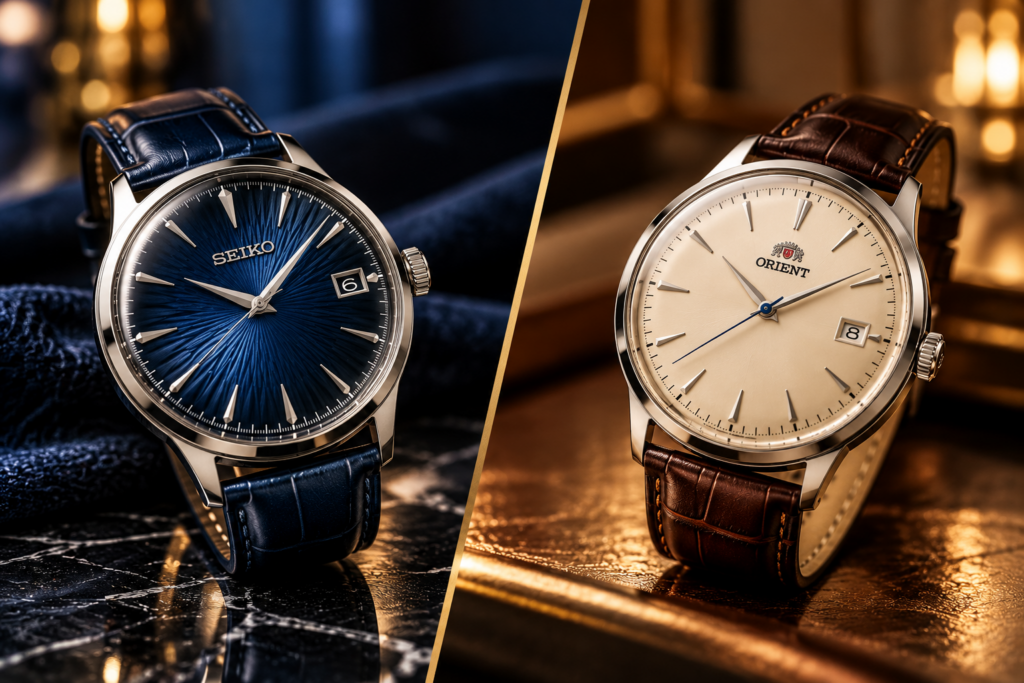
The Presage Cocktail Time SRPB43 is the more extroverted watch.
Its radial pressed dial shifts with the light, sending a silvery blue shimmer across slim indices and silver-toned hands.
A box-shaped Hardlex crystal adds to the sense of depth, giving the dial more visual drama than its straightforward specification sheet might suggest.
The date window is present without crowding the face, and the black leather strap helps pull the watch back toward evening formality.
The Bambino Version 7 takes the opposite route.
Its white dial, slim hands and simple markers create a more traditional impression, with the domed mineral crystal softening the whole face.
It’s the sort of watch that doesn’t try to hold the room, which can be exactly the point with tailoring.
Neither model uses an open-heart display on the dial, so both preserve the clean symmetry expected from a dress watch.
Case proportions change the personality
The Seiko measures 40.5 mm wide and 11.8 mm thick, giving the sunburst dial enough space to breathe while remaining reasonably cuff-friendly.
The Orient is smaller across the wrist at 38.4 mm, with a 44 mm lug-to-lug length and a 12.5 mm thickness.
That makes the Bambino the more compact choice, even if its domed-crystal profile gives it slightly more height.
For smaller wrists, the Orient’s diameter may feel closer to traditional dress-watch proportions.
Both watches use 20 mm strap fittings, so moving from black leather to brown leather, suede or another texture is simple.
Movements and the details owners notice
Inside the Seiko is the 23-jewel 4R35 automatic movement, with hand-winding, stop-seconds setting and approximately 41 hours of power reserve.
The Orient uses the F6724 automatic movement, also with hand-winding and stop-seconds setting, and a power reserve of roughly 40 hours.
There isn’t much between them for mechanical endurance.
The Orient has the tighter stated accuracy rating at +25 to -15 seconds per day, compared with the Seiko’s +45 to -35 seconds per day.
Both watches place their movements behind exhibition case backs, leaving the dials uncluttered while still allowing a view of the mechanics off the wrist.
The Seiko closes with a three-fold push-button clasp, which can reduce repeated bending at a buckle hole.
The Orient uses a conventional pin buckle, a simpler arrangement that is easy to understand and inexpensive to replace.
Water resistance is modest in both cases.
The Seiko is rated to five bar, equivalent to approximately 50 metres of static pressure, while the Orient is rated to 30 metres.
Given the leather straps and dress-watch intent, both are better suited to daily splashes than swimming.
Neither watch uses a sapphire crystal, so owners should expect the Hardlex and mineral crystals to be more vulnerable to everyday scratching than sapphire.
Details & Specifications
| Brand and model | Seiko Presage Cocktail Time SRPB43 and Orient Bambino Version 7 RA-AC0M03S30B |
|---|---|
| Case material | Steel |
| Case size | Seiko 40.5 mm wide and 11.8 mm thick. Orient 38.4 mm wide, 44 mm lug-to-lug and 12.5 mm thick |
| Dial | Seiko silvery blue radial pressed sunburst dial. Orient white dial with simple markers |
| Crystal | Seiko box-shaped Hardlex. Orient domed mineral crystal |
| Movement | Seiko 23-jewel 4R35 automatic. Orient F6724 automatic |
| Functions | Time, date, hand-winding and stop-seconds setting on both models |
| Power reserve | Approximately 41 hours for Seiko. Roughly 40 hours for Orient |
| Stated accuracy | Seiko +45 to -35 seconds per day. Orient +25 to -15 seconds per day |
| Case back | Exhibition case back on both models |
| Strap | Black leather strap with 20 mm fittings on both models |
| Clasp | Seiko three-fold push-button clasp. Orient pin buckle |
| Water resistance | Seiko five bar, approximately 50 metres of static pressure. Orient 30 metres |
| Price | Seiko lists at $450. Orient has a $430 regular price and is advertised at $295 |
Value depends on how much presence you want
The Seiko justifies its premium most clearly through dial work, its thinner case and its folding clasp.
It’s the better fit for someone who wants a formal watch that still adds visible character to a jacket cuff.
The Orient makes its case through proportion and restraint.
At its advertised $295 price, it undercuts the Seiko by $155 while retaining an automatic movement, date display, hand-winding, stop-seconds setting and an exhibition case back.
Choose the Presage if you want the dress watch to catch the light and invite a second look.
Choose the Bambino if you prefer a smaller, quieter watch that understands the value of staying in the background.