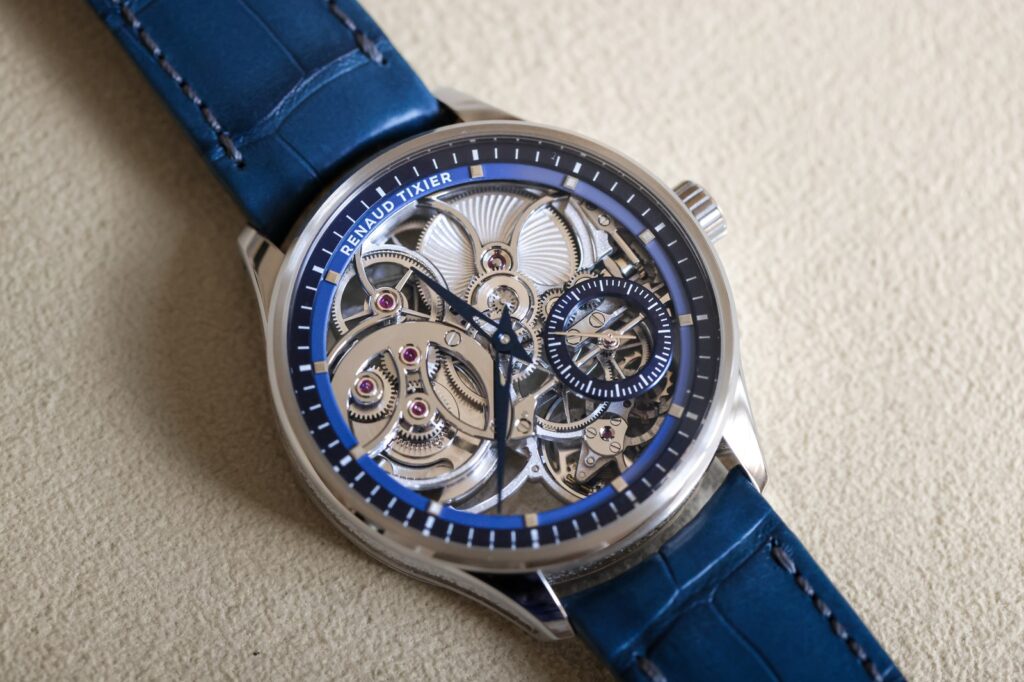
Renaud Tixier’s Monday was already an unusual proposition, built around a micro-rotor system designed to recover energy from motion that would normally be wasted.
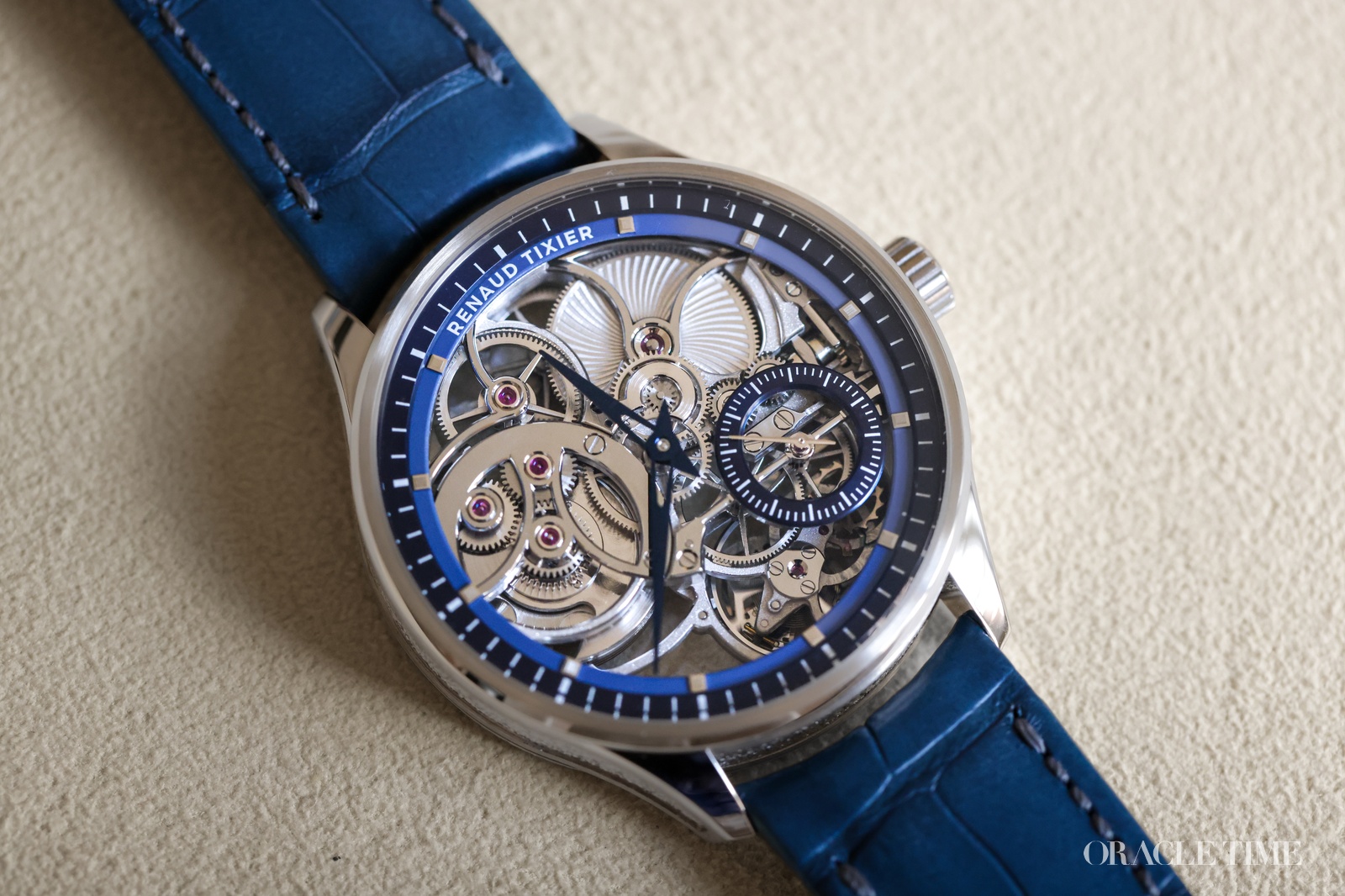
The Monday Skeleton brings that idea into full view, stripping away the dial and putting the architecture, finishing and mechanical logic of the watch on display.
It also suggests that the brand’s first concept has more room to develop before the promised next chapter arrives.
At a glance
- Renaud Tixier has introduced the Monday Skeleton, an openworked version of its Monday watch.
- The calibre RVI2025 uses a platinum micro-rotor with an internal flywheel and spring system designed to improve winding efficiency.
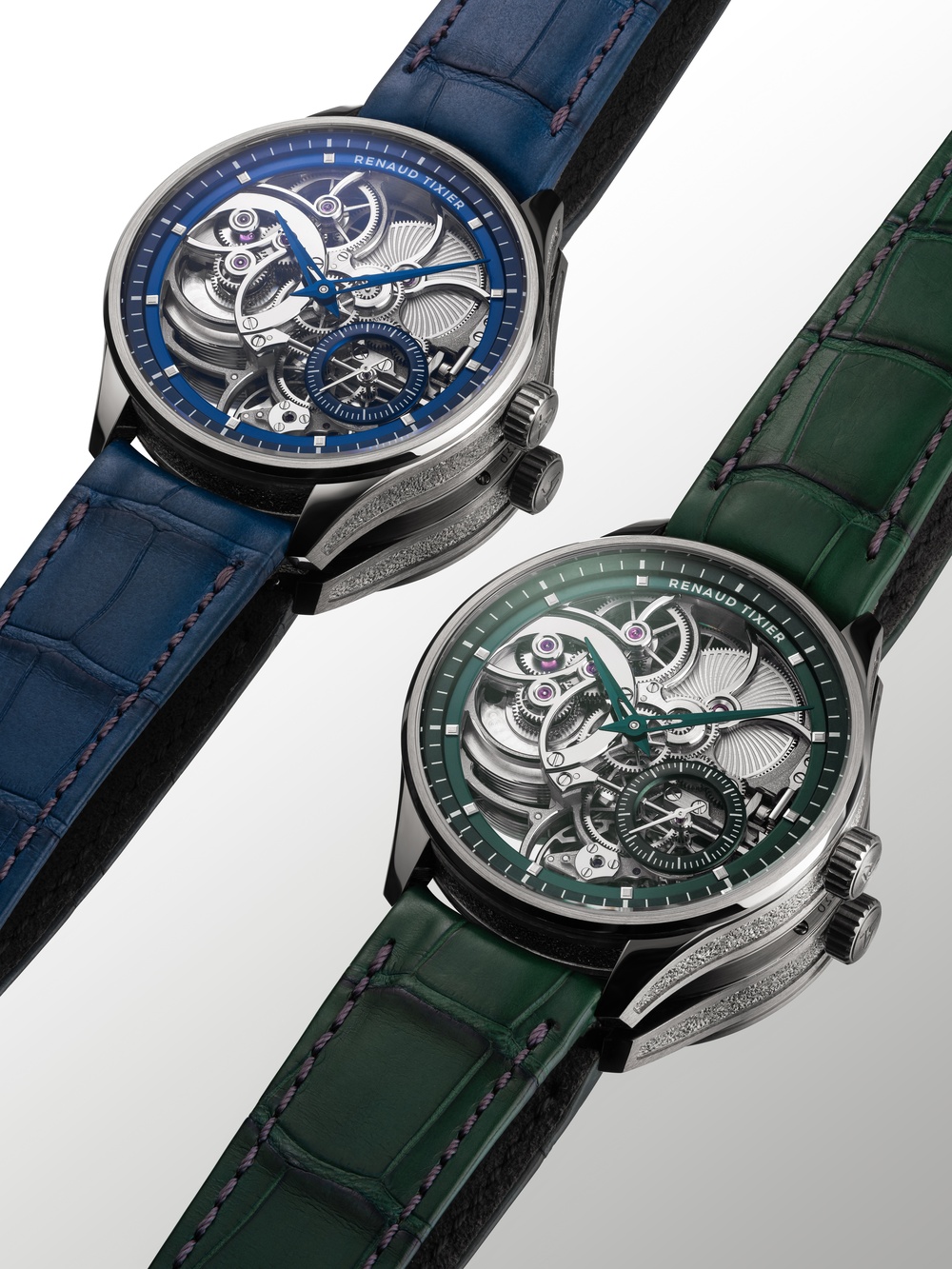
- Each colour version is limited to 15 pieces, with petrol blue and green executions confirmed.
A micro-rotor built around recovered motion
The Monday is the work of Dominique Renaud and Julien Tixier, a pairing that connects deep complication experience with contemporary independent watchmaking craft.
Renaud co-founded Renaud & Papi with Giulio Papi in 1986, a complications specialist whose work has been associated with brands including Audemars Piguet, Richard Mille, IWC, Jaeger-LeCoultre and A. Lange & Söhne.
Tixier is a watchmaker and prototypist in his early thirties who previously built prototypes for Laurent Ferrier before setting up independently in the Vallée de Joux.
The technical centre of the Monday is its energy recovery system, housed inside the hub of a platinum micro-rotor.
Micro-rotors allow a slimmer movement architecture and keep much of the calibre visible, but their smaller mass can make winding less efficient than a full rotor.
Renaud Tixier’s answer is a second, smaller platinum flywheel coupled to a spring inside the rotor assembly.
When the rotor swings and stops, the flywheel continues moving through inertia, loading the spring before that stored energy is released to help set the rotor back in motion.
The aim is to capture small wrist movements that might not meaningfully move a conventional micro-rotor.
The same assembly also serves a protective role, with a declutching mechanism that disengages the flywheel from its arbor during a hard shock before re-engaging once the impact has passed.
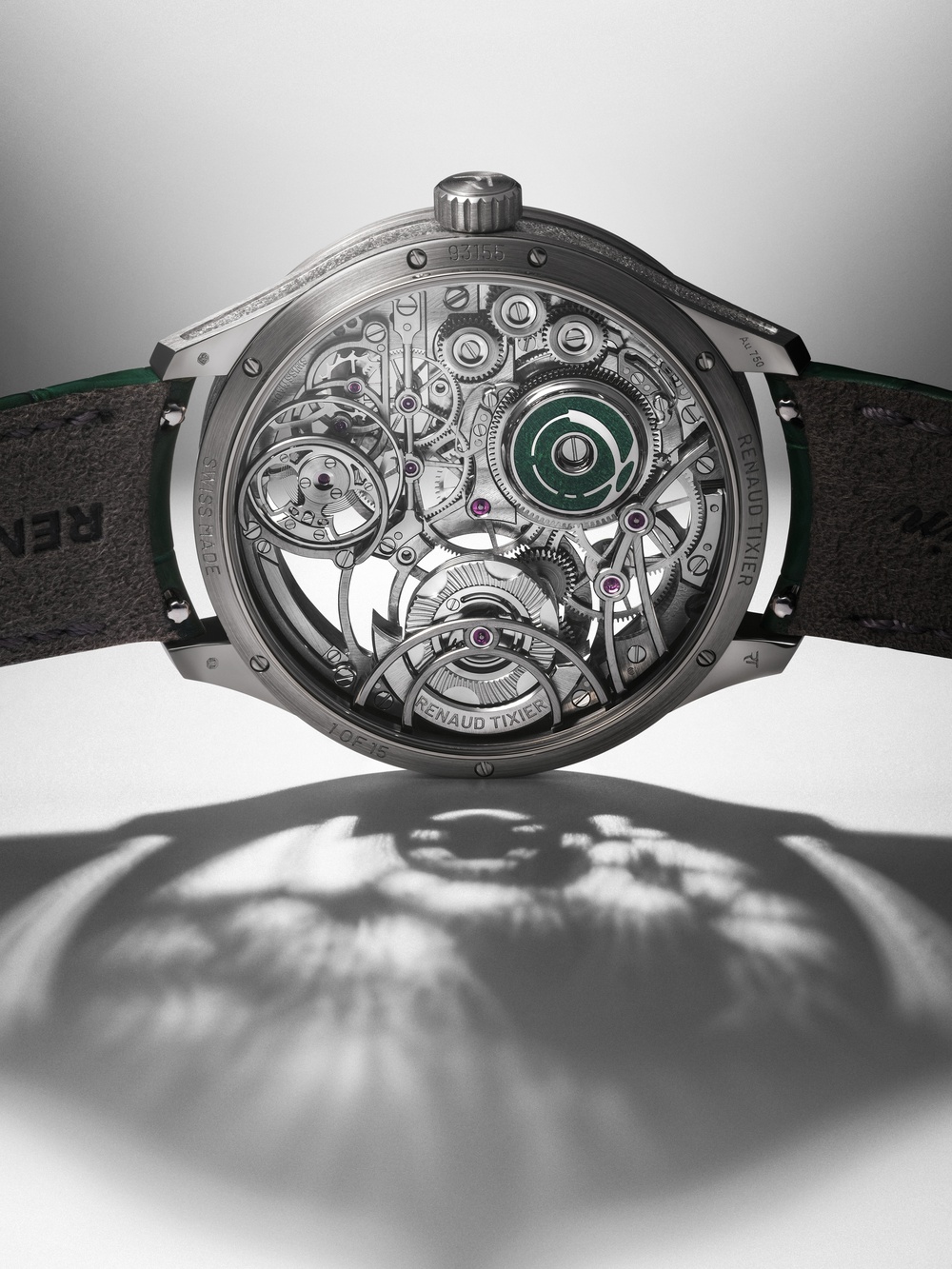
The workshop calls the freely oscillating element the dancer, a name that makes more sense when the caseback view reveals its movement.
Renaud Tixier says the system makes the micro-rotor around 40 per cent more efficient than a standard one.
In the Monday Skeleton, the calibre is stated to deliver at least 72 hours of power reserve, compared with 60 hours in the original Monday.
The Monday stripped into a more technical watch
The Monday Skeleton is the third expression built around this energy-recovery concept.
The original Monday used a minimalist grey dial, while the Monday Organica introduced a translucent blue enamel dial made by Ateliers Olivier Vaucher and later appeared in Black and Bordeaux editions, each limited to seven pieces.
Here, the dial is removed to expose the unconventional layout of the movement, now designated RVI2025.
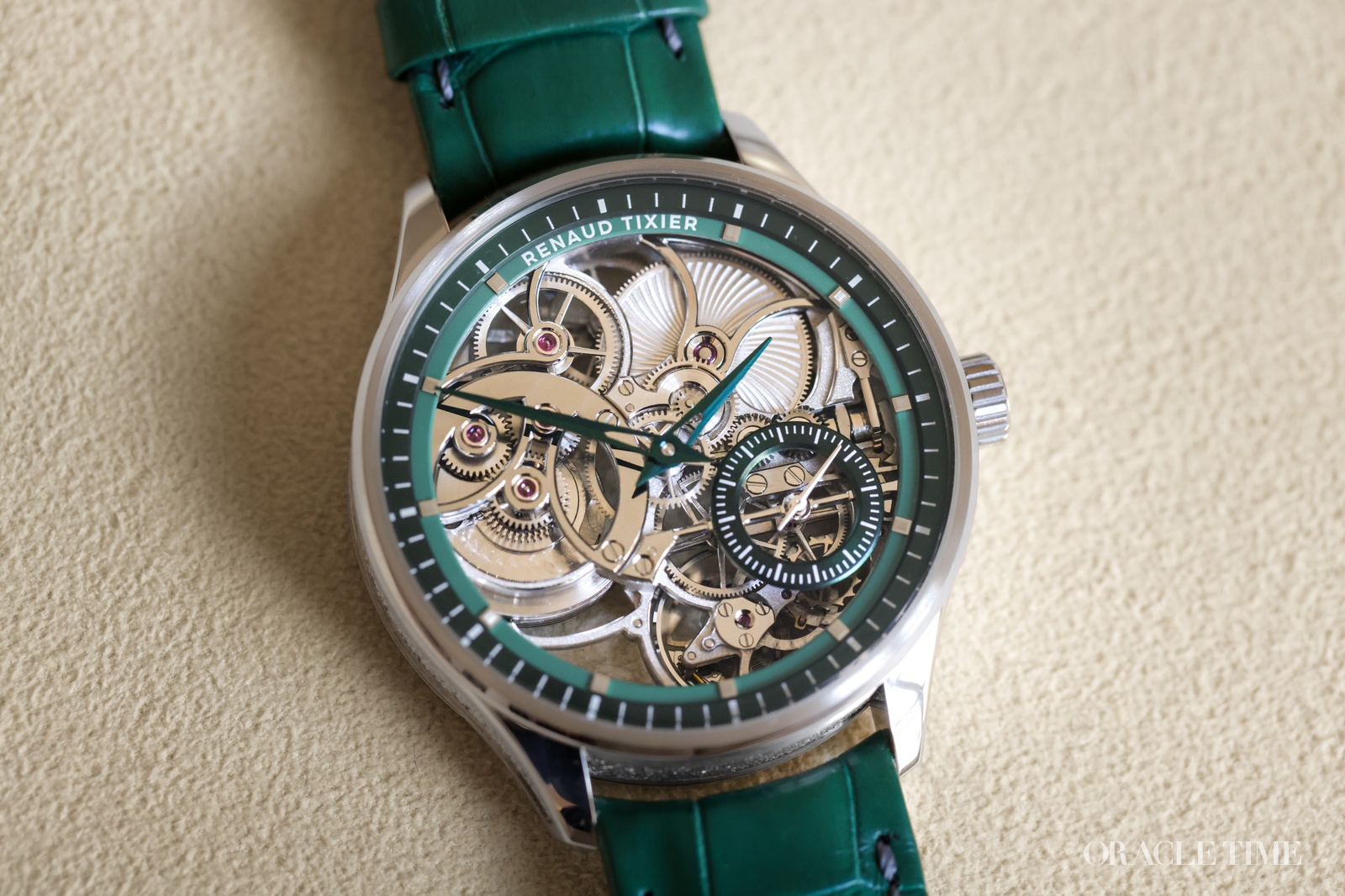
The calibre has 262 components, all finished and decorated by hand in the workshop in Tolochenaz.
Much of the watch’s personality comes from Julien Tixier’s finishing language, particularly the hand-cut inward angles.
There are 238 inward angles in the Monday Skeleton, accompanied by anglage, black polishing, bridge rounding, Côtes de Genève, sunray brushing and circular graining.
The caseback adds a more decorative counterpoint, with a barrel ratchet covered by a bridge that is hand engraved, chased and filled with grand feu enamel matched to the colour of the watch.
It is also the clearest place to observe the dancer system at work.
White gold, colour accents and hand-finished surfaces
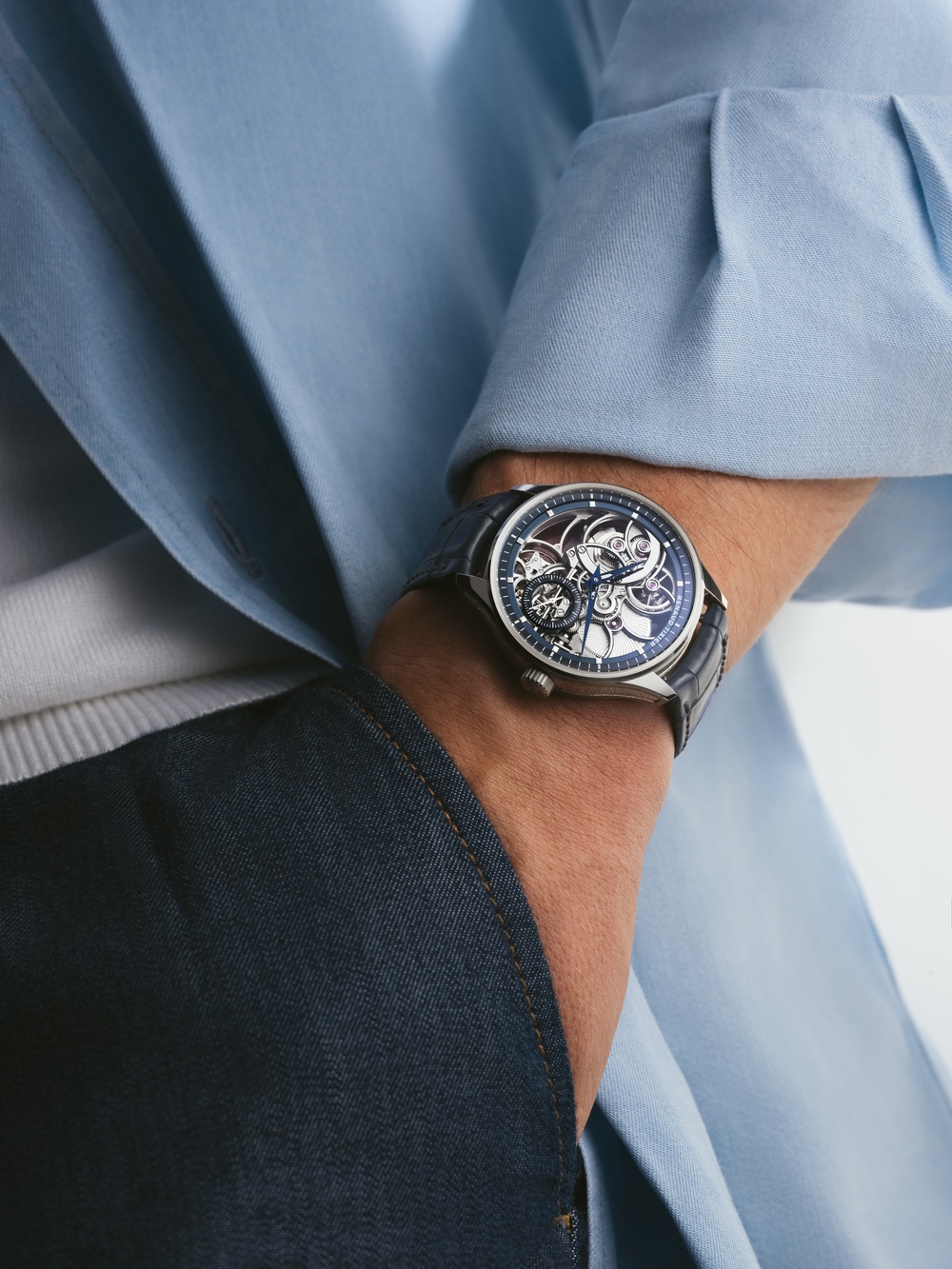
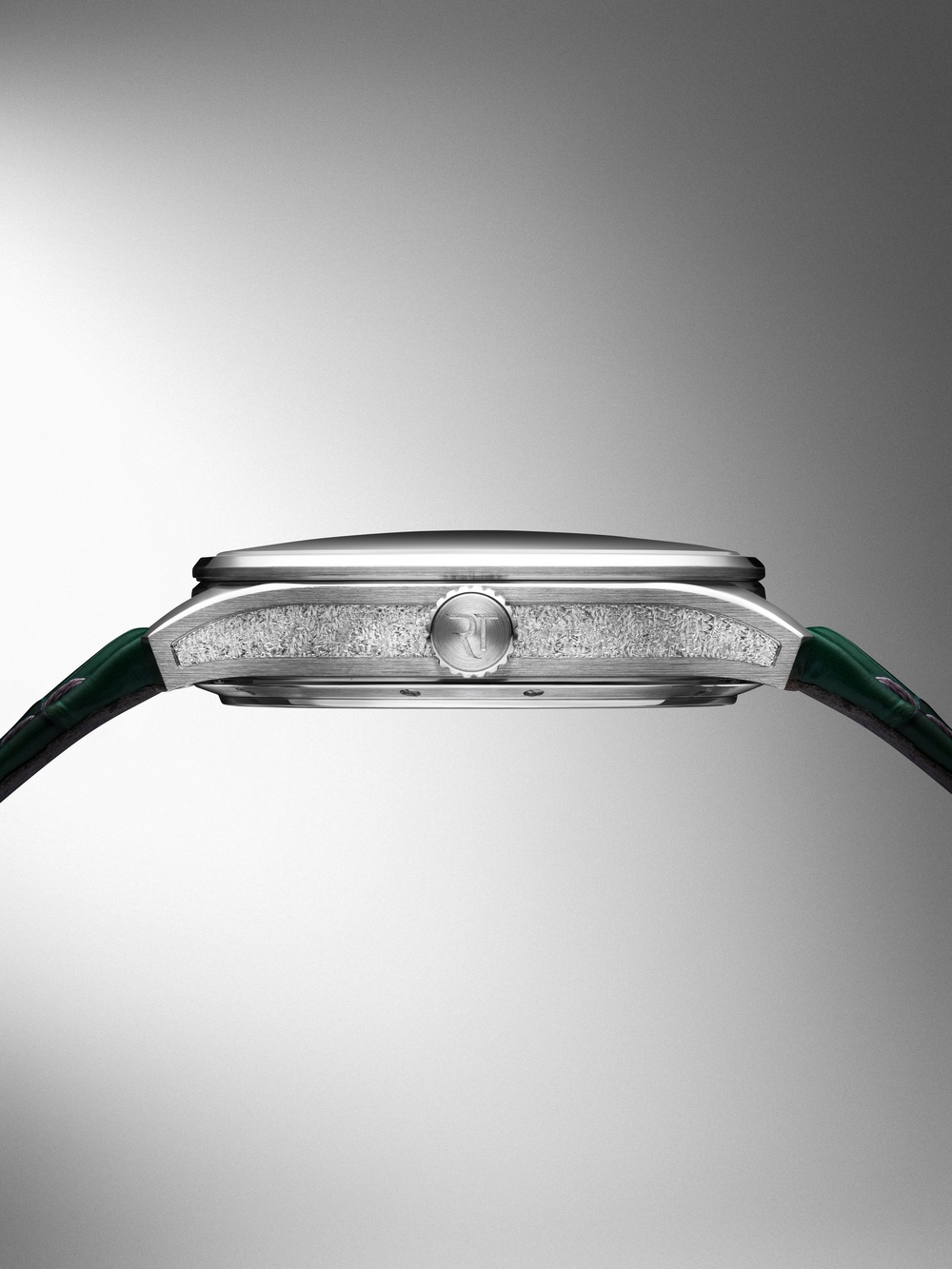
The Monday Skeleton keeps the familiar 40.8mm case in 18ct white gold, with hand-engraved frosted flanks and a thickness of 12.6mm including the domed crystal.
From the front, the openworked construction gives the watch a sharper and more technical presence than the dialled versions.
A brushed rehaut carries faceted appliques on its lower level, with a white minute track above.
The dauphine-style hour and minute hands are skeletonised, polished and satin finished.
At 3 o’clock, the small seconds sits on a satin-finished counter in either petrol blue or green.
That colour carries through to the hand-stitched alligator strap, giving each version a clearer identity without masking the movement architecture.
Details & Specifications
| Brand | Renaud Tixier |
|---|---|
| Model | Monday Skeleton |
| Case size | 40.8mm |
| Case material | 18ct white gold |
| Case thickness | 12.6mm including domed crystal |
| Dial | Skeletonised, with brushed rehaut and white minute track |
| Movement | Calibre RVI2025 |
| Components | 262 |
| Winding system | Platinum micro-rotor with internal platinum flywheel and spring energy recovery system |
| Power reserve | At least 72 hours |
| Finishing | 238 hand-cut inward angles, anglage, black polishing, bridge rounding, Côtes de Genève, sunray brushing and circular graining |
| Small seconds | At 3 o’clock, in petrol blue or green |
| Strap | Hand-stitched alligator strap matched to the watch colour |
| Limitation | 15 pieces per colour |
A first chapter that keeps expanding
Renaud Tixier was conceived as a seven-watch series, with each model built around a new idea and named after a day of the week.
Monday was meant to be the opening chapter, yet the Skeleton shows how much the brand still sees in its first mechanical theme.
For collectors drawn to independent watchmaking, the appeal is not just in the openworked dial or the low production numbers.
It’s in the way the watch makes a technical idea legible, turning a hidden efficiency problem into the central theatre of the piece.