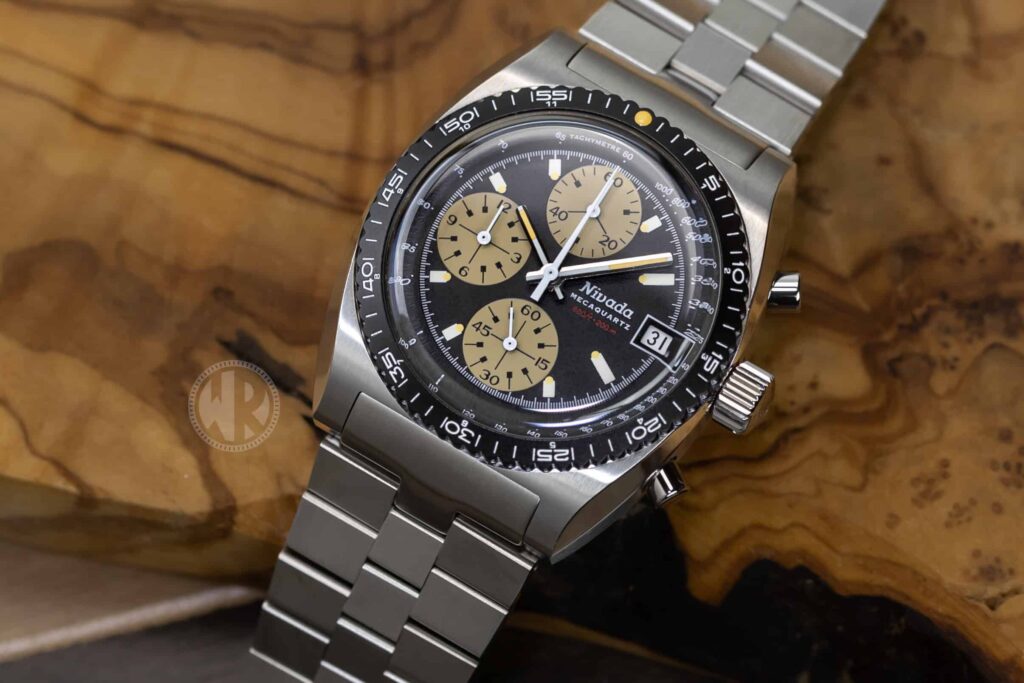
The Nivada Grenchen Autochron MecaQuartz takes the shape of a late-1970s Nivada Grenchen prototype and gives it a modern, lower-cost chronograph movement. It keeps the distinctive 38mm cushion case, 200 meters of water resistance, screw-down crown and sapphire crystal of the automatic Autochron, but starts at $530 on a strap instead of the automatic version’s $2,500 bracelet price.
A rare prototype design, not a simple catalog remake
Since its return, Nivada Grenchen has leaned heavily on its historical archive. The Autochron MecaQuartz follows that pattern, but with an unusual source: a late-1970s prototype that reportedly never reached full production, with fewer than 20 examples said to have been made.
The Autochron name itself predates that prototype. Earlier Autochron Taravana models existed in the 1970s, including chronographs with more pilot-style cues. Some examples used long chronograph seconds hands with an airplane-shaped counterbalance. The revived watch, however, is closest to the later prototype, especially in its case profile.
One detail worth noting is the naming. Nivada Grenchen sells the watch as the Autochron, but the name does not appear on the dial or caseback. The caseback instead uses the Chronosport name.
The price is the major differentiator
The MecaQuartz version is positioned far below the automatic model. The automatic Autochron on bracelet is priced at $2,500, while the MecaQuartz starts at $530 on a strap and $730 on the bracelet.
That price difference comes while preserving several key external specifications. Both versions use the same 38mm cushion-style stainless steel case, offer 200 meters of water resistance, include a screw-down crown and use a sapphire crystal.
Case dimensions and specifications
- Diameter: 38mm
- Thickness: 10.8mm without the crystal
- Case material: 316L stainless steel
- Crystal: double-domed sapphire
- Lug-to-lug: 46.5mm
- Lug width: 20mm, with bracelet flare to about 24mm
- Water resistance: 20ATM / 200 meters
- Weight on bracelet: 166.3 grams
- Movement: Seiko VK67 mecaquartz with date
- Battery life: approximately 3 years
- Accuracy: ±20 seconds per month
- Retail price: $530 on strap, $730 on bracelet
A cushion case with strong 1970s character
The case is one of the watch’s defining elements. It is a square-ish cushion shape that widens toward the lugs, giving the watch a period-correct 1970s look without relying only on dial color or typography.
The finishing combines satin brushing across the case with a broad polished chamfer along the top edge. That polished bevel helps define the geometry and gives contrast to the otherwise brushed steel surfaces.
Although the case measures 38mm across, the screw-down crown and pushers bring the measured width to about 42mm. Combined with the bracelet design, the watch can read larger on the wrist than its diameter suggests.
Bezel design favors appearance over grip
The bezel sits within a recessed area of the case, especially around 3 and 9 o’clock. Visually, this adds to the watch’s unusual profile. Practically, it limits where the bezel can be gripped, making it easiest to turn from 12 and 6 o’clock.
The bezel is bidirectional and has a matte black coated aluminum insert. It does not appear to have strong click feedback, though it also is not described as loose. Its main appeal is its vintage appearance and how it pairs with the matte black dial.
Seiko VK67 mecaquartz instead of an automatic caliber
The original prototype is believed to have used a Lemania movement, while the modern automatic Autochron uses a Valjoux 7750. Both are two-register chronographs. The MecaQuartz version is different, using a Seiko VK67 movement with a three-register layout.
The VK67 offers a running seconds subdial, plus 60-minute and 12-hour chronograph counters. Like many mecaquartz chronographs, the chronograph seconds hand snaps back instantly when reset, giving some of the tactile behavior associated with a mechanical chronograph while retaining quartz accuracy and lower maintenance demands.
Dial layout, texture and legibility
The currently available MecaQuartz version uses a matte black dial with a subtle micro-pebble texture. It is paired with tan subdials and a matching matte black bezel. Salmon and panda dial variants also existed as limited editions.
The hour and minute hands are steel, while the chronograph hands are white. The watch also uses two lume tones across the hands, indices and dial dots, with tan or old-radium-style lume helping tie the color palette together.
The date sits at 3 o’clock. A tachymeter scale is also present, though it can be difficult to read because of distortion from the large double-domed sapphire crystal.
Lume is attractive but not especially long lasting
The lume presentation suits the vintage-inspired design, particularly with the contrasting tones used on the dial and hands. However, brightness and longevity are not described as a strength. It looks good for a short period, but the source review notes that it should not be expected to remain clearly visible several hours later in the dark.
Strap choices are broad, but the bracelet changes the watch
Nivada Grenchen offers the Autochron MecaQuartz with multiple strap options, including leather straps and a tropic-style rubber strap. The bracelet, however, gives the watch a different presence.
The bracelet adds $200 to the price, bringing the watch to $730, but it also strengthens the case’s visual impact. It uses rectangular and square links, starts at 20mm between the lugs, then flares underneath to nearly 24mm before tapering to 18mm. That flare, combined with the chronograph pushers and crown, helps the 38mm case wear closer to a 40mm watch.
The bracelet is brushed on the top surfaces and highly polished on the sides, echoing the polished chamfer of the case. It uses small links and screw-based sizing. The clasp is dual finished and carries the NG logo. The reviewed version uses a traditional clasp with several sizing holes rather than an on-the-fly micro-adjustment system, though some limited editions reportedly used a different clasp with on-the-fly adjustment.
Wrist presence and fit
On a 7.5-inch wrist, the watch is described as comfortable and visually well balanced on the bracelet. The larger end links, flared bracelet, pushers and crown all help offset the compact 38mm diameter.
The bracelet is also said to be long enough to fit an 8-inch wrist, which is not always the case with watches of this size. For those who usually prefer watches in the 40mm to 42mm range, the Autochron MecaQuartz may wear larger than the headline number suggests, though it remains a true 38mm case.
Who the Autochron MecaQuartz is for
The appeal of this model is not simply that it is less expensive than the automatic Autochron. It offers a distinctive case, strong water resistance, a screw-down crown, a sapphire crystal and a chronograph movement that delivers useful counters with quartz accuracy.
Buyers who insist on an automatic chronograph may still prefer the 7750-powered version. But for those who are comfortable with mecaquartz, the Autochron MecaQuartz delivers much of the same design language and external specification at a substantially lower price.