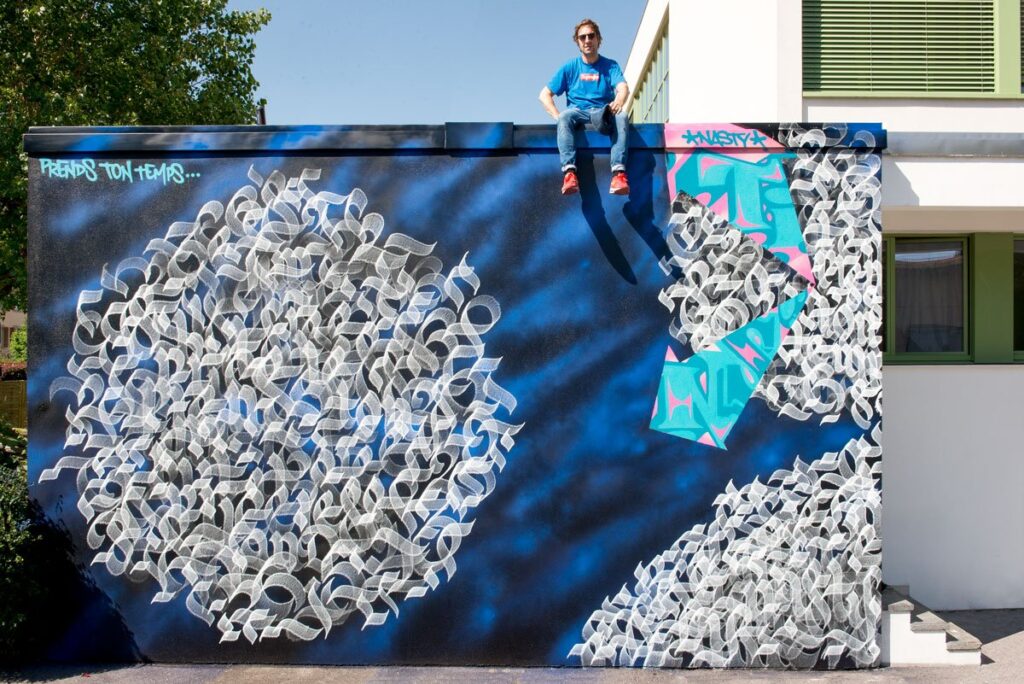
Nasty occupies a particular place in French street art because his work never really left the city that formed it.
Born in Paris and active since the late 1980s, he emerged from the era when graffiti, hip-hop and the metro system gave the French capital a new visual rhythm.
Decades later, his bold lettering and salvaged urban signage have become a distinctive artistic language, one that treats the city not just as a backdrop, but as material, memory and archive.

At a glance
- Nasty is a pioneering Parisian graffiti artist whose career began during the late 1980s French graffiti movement.
- His work is known for vivid lettering, paint layers and the use of authentic Parisian street and metro signage.
- He remains visible internationally through exhibitions, collectors, institutions and brand collaborations including Azzaro Wanted.
Paris as a working surface
Nasty’s early reputation was built on trains, metro lines and the charged public spaces of Paris.
That period, often described as a golden age for French graffiti, gave a generation of writers a moving canvas and a cultural framework shaped by hip-hop and New York graffiti.
For Nasty, the city became more than a place to paint.

Its signs, enamel plaques, transport markers and worn surfaces fed directly into his work, creating a visual identity rooted in the infrastructure of everyday life.
This connection to Paris is central to his appeal.
His pieces often feel like fragments of the capital lifted from the street, reworked with colour and gesture, then returned to public memory in a new form.

Lettering, signage and urban archaeology
Nasty’s style is instantly legible without being simple.
His compositions combine graffiti lettering, bright colour, drips, tags and layered textures, often arranged over authentic street signs or metro elements.
The result sits between painting and urban archaeology.

Rather than treating signage as a neutral support, he uses it as a carrier of place, turning objects that once directed commuters and pedestrians into charged artworks.
This is where his practice becomes especially compelling for collectors.
A Nasty work can hold the energy of graffiti while also preserving traces of a changing Paris, from transport culture to the graphic codes of the street.

His use of real urban artefacts also avoids nostalgia as decoration.
The pieces don’t simply romanticise the city, they show how its visual systems can be broken open, tagged, layered and made personal.
From metro culture to international recognition
Nasty belongs to the generation that helped push graffiti in France from a marginal practice into a recognised artistic movement.

He did that without abandoning the vocabulary that made the work powerful in the first place.
As street art gained space in galleries, museums and art fairs, his practice offered a clear bridge between underground writing culture and the contemporary art market.
His work has been shown across Europe, Asia and the United States, reaching audiences that may never have encountered his early interventions in Paris.
Recent visibility at Beyond The Streets Paris in the Grand Halle de la Villette placed him within a broader conversation about graffiti history, alongside major American figures and other leading names in urban art.
That context matters because Nasty’s career is not just about individual style.
It reflects the moment when French graffiti found its own confidence, its own lettering traditions and its own relationship with the city.
Collaborations that keep the street in view
Nasty’s work has also moved into fashion, lifestyle and cultural collaborations without losing its connection to street culture.
Projects such as Nasty x Azzaro Wanted show how his graffiti language can translate into commercial settings while remaining visually tied to his Parisian identity.
These collaborations have helped introduce his work to wider audiences, particularly those who may first encounter graffiti through design, fashion or luxury culture.
The best of these projects work because they don’t smooth away the tension in his practice.
They keep the colour, the typography and the urban charge that made his name resonate in the first place.
More than three decades after he began painting in Paris, Nasty remains relevant because he treats the city as something alive.
His work captures the speed, friction and memory of urban life, then transforms overlooked objects into pieces that carry both street energy and cultural history.
For anyone interested in French graffiti, contemporary street art or the visual identity of Paris, Nasty remains an essential figure to understand.