Iceland is one of the few places where a day can move from glacier ice to volcanic sand to steam rising out of the ground.
That closeness is what gives the island its charge.
The country isn’t defined by a single view so much as a sequence of abrupt shifts that keep resetting your sense of scale.

At a glance
- Iceland brings glaciers, waterfalls, lava fields, black beaches and geothermal landscapes into unusually close reach.
- Guided travel can add geological context, local knowledge and safer access to changing natural environments.
- The island suits travellers who value dramatic scenery, flexible itineraries, photography and a sense of discovery.
Volcanic terrain that still feels alive
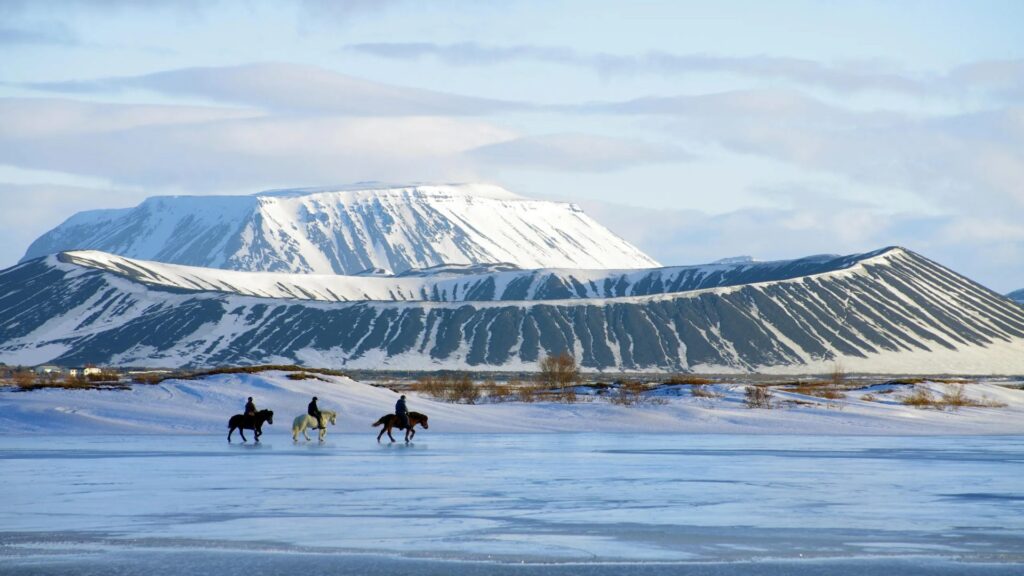
Volcanoes have left their signature across much of Iceland, from broad lava fields to black-sand coastlines and rough mountain profiles.
Some landscapes were formed thousands of years ago, while younger lava fields remind you that the island is still being made.
The geothermal areas make that energy visible.

Steam drifts from the ground, mud pools bubble, hot springs gather mineral colour and geysers turn the earth’s pressure into sudden movement.
Even without a detailed understanding of geology, it’s hard not to feel the force beneath the surface.
With the right guide, a stretch of dark rock becomes more than scenery.

It becomes a record of eruptions, settlement, weather and the restless systems that continue to shape Iceland today.
Glaciers up close
Iceland’s ice offers an entirely different kind of drama.
Glaciers flow down from the mountains, carving and reshaping the land as they move with almost imperceptible force.

From a roadside viewpoint, they can look monumental and distant.
Closer in, the details take over, with blue ice, volcanic ash, deep crevasses and formations that can change from season to season.
For travellers, that closeness requires judgement.

Guided glacier walks and natural ice cave visits depend on conditions, and these are places where experience matters.
A skilled guide doesn’t just improve safety.
They help explain the ice as a living landscape rather than a static backdrop, which makes the encounter far more memorable.
Waterfalls, black beaches and the Atlantic edge
For a country often described through fire and ice, water is the constant thread.
Waterfalls appear with remarkable frequency, dropping from cliffs, slipping into canyons or cutting through moss-covered valleys.
Some can be approached closely, while others are best understood from a distance, where the scale becomes clearer.
Their character changes with the season.
Warmer months can bring huge volumes of meltwater, while winter may freeze the surrounding rock and soften the scene with snow.
The coast adds a darker, wilder register.
Iceland’s beaches are rarely gentle leisure landscapes, but places of volcanic sand, basalt formations, sea stacks, high cliffs and powerful Atlantic waves.
Standing on a black beach beneath a heavy sky has a cinematic quality, though the feeling is more physical than picturesque.
The sound of the surf, the wind and the scale of the shoreline are what stay with you.
Light, darkness and the value of flexibility
Iceland’s landscapes change again after dark, especially in winter when long nights can create the conditions for northern lights viewing.
There’s no certainty with the aurora, and that unpredictability is part of the experience.
When clear skies, low light pollution and strong activity align, green light moving over mountains or open countryside can alter the entire mood of a journey.
Summer sits at the opposite extreme.
Around the longest days, darkness barely settles, and soft light can linger late into the night.
For photographers, that extended glow is difficult to resist.
It also means well-known viewpoints can feel quieter and more personal when visited outside the usual rhythm of the day.
This is where the way you travel becomes important.
A strict schedule can cover ground, but Iceland often rewards space in the plan.
The weather shifts quickly, clouds lift without warning and an unplanned stop can become the moment you remember most clearly.
For travellers considering a more tailored trip, luxury in Iceland is less about excess and more about access, expertise and time.
A private vehicle, an informed guide and an itinerary shaped around your interests can make the country feel less like a checklist and more like a conversation with the landscape.
The great pleasure of Iceland is that it still has the power to surprise, even when you think you know the images already.
Give the island enough time, and the spaces between the famous landmarks become just as compelling as the names you came to see.