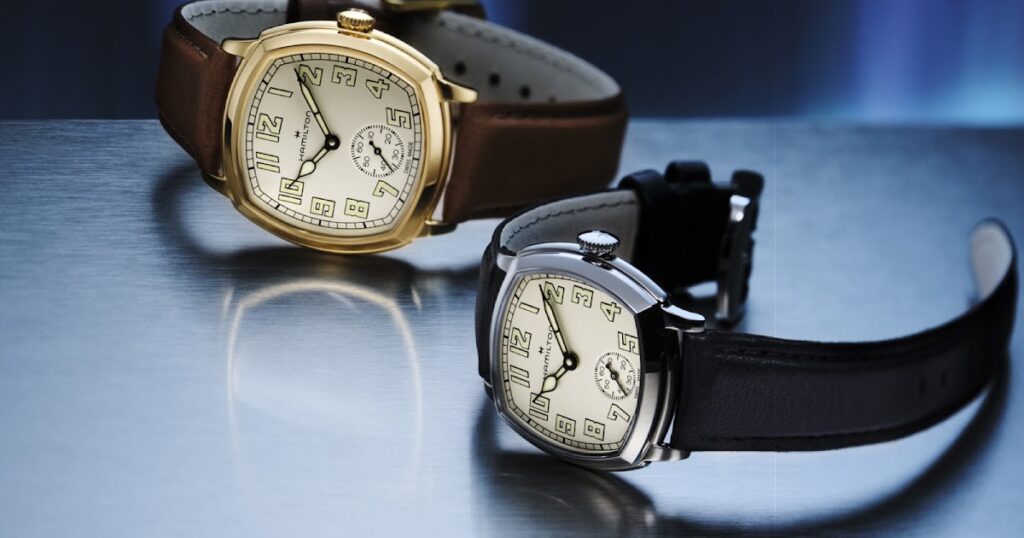
Hamilton’s latest American Classic Cushion watches look back to a moment when the wristwatch was still finding its modern identity.
Inspired by the brand’s Cushion Plain and Cushion Engraved models from 1926, the collection revives a compact square silhouette with softened edges and the crisp geometry of the Art Deco period.
The result is a mechanical dress watch family that feels deliberately restrained, with slim cases, small seconds and a hand-wound calibre chosen to preserve the proportions.

At a glance
- Hamilton has introduced the American Classic Cushion collection, inspired by its cushion-shaped watches from 1926.
- The watches use slim 30 x 30 mm and 34 x 34 mm cases with domed sapphire crystals, exhibition backs and the hand-wound H-42 calibre.
- Prices range from €995 or US$995 to €1,095 or US$1,095, depending on the reference.
Art Deco proportions in a modern case
The cushion case is the point of the collection, and Hamilton has kept the shape compact rather than stretching it into a contemporary oversized statement.
Both case sizes measure as true squares, with 30 x 30 mm and 34 x 34 mm options, each with a slim 8.1 mm profile.
That low height matters because the design depends on elegance rather than visual mass.

The cases are stainless steel, with some references finished in a yellow gold-coloured PVD coating for a warmer period feel.
A domed sapphire crystal with anti-reflective coating sits above the dial, while a screw-secured sapphire exhibition case back shows the movement.
Dials that lean into the 1926 inspiration
The smaller 30 mm models bring the widest contrast in dial character.

Reference H36109710 has a beige sandblasted dial with Arabic numerals and Super-LumiNova, paired with a black or brown leather strap using Hamilton’s Easy Click system.
Reference H36109720 switches to a white enamel dial with Roman numerals and Super-LumiNova.
The third 30 mm model, reference H36119520, combines the yellow gold-coloured PVD-coated case with a beige dial.

In the larger 34 mm format, reference H36139520 also uses a yellow gold-coloured PVD-coated case with a beige dial and Arabic numerals.
Reference H36129730 brings a black dial with Arabic numerals, while H36149710 pairs an engraved case with a silver sunray-finished dial and Arabic numerals.
The hand-wound H-42 keeps the case slim
Hamilton powers the American Classic Cushion collection with the H-42, a new hand-wound mechanical calibre based on the ETA 7001.

That architecture traces back to the Peseux 7001 introduced in the 1970s, a movement family long associated with slim mechanical watches.
Here, the movement choice supports the design rather than competing with it.
The H-42 includes a Nivachron balance spring, a small seconds display at 6 o’clock and a 57-hour power reserve.

Water resistance is rated to 5 bar, equivalent to 50 metres or 165 feet.
Details & Specifications
| Brand | Hamilton |
|---|---|
| Collection | American Classic Cushion |
| Inspiration | Hamilton Cushion Plain and Cushion Engraved models from 1926 |
| Case sizes | 30 x 30 mm and 34 x 34 mm |
| Case material | Stainless steel, with yellow gold-coloured PVD-coated variants |
| Thickness | 8.1 mm |
| Crystal | Domed sapphire with anti-reflective coating |
| Case back | Screw-secured sapphire exhibition case back |
| Movement | H-42 hand-wound mechanical calibre based on the ETA 7001 |
| Display | Hours, minutes and small seconds at 6 o’clock |
| Balance spring | Nivachron |
| Power reserve | 57 hours |
| Water resistance | 5 bar, 50 metres or 165 feet |
| 34 mm lug width | 18 mm |
| 30 mm references | H36109710, H36109720, H36119520 |
| 34 mm references | H36139520, H36129730, H36149710 |
| Price | From €995 or US$995 to €1,095 or US$1,095 |
A compact alternative to the usual dress watch
The American Classic Cushion isn’t trying to modernise the dress watch by making it larger or louder.
Its appeal is more specific than that, aimed at wearers who like vintage proportion, visible mechanical character and a case shape with real historical grounding.

For Hamilton, it’s a smart use of archive design, bringing the 1926 cushion form back with enough mechanical substance to make it more than a style exercise.