Cosimo I de’ Medici, the first Grand Duke of Tuscany, used scientific instruments to project power as clearly as he used art, architecture and politics. In his Florence, clocks, astrolabes, globes and planetary mechanisms were not only tools for measuring time or mapping the heavens. They expressed a courtly ideal in which knowledge, order and authority were closely linked.
Timekeeping as a language of power
Across Europe’s royal courts, elaborate clocks and watches carried meanings beyond their practical function. They signaled prestige, technical sophistication and command over an ordered world. For the Medici, whose rise in Florence was built on wealth, banking and political influence, scientific patronage became another way to define civic and dynastic identity.
The Medici Bank helped make the family one of the most powerful forces in 15th-century Europe. That financial strength supported Florence’s transformation into a major center for trade, art and scientific work. By the time of Cosimo I, this culture of patronage extended deeply into instruments that measured, illustrated and interpreted the universe.
Cosimo I’s workshops and scientific court
Cosimo I supported specialized workshops where mathematicians, engineers and artisans worked together. Their output included globes, armillary spheres, astronomical clocks and other instruments that brought celestial motion into visible, mechanical form.
These objects were displayed at court as demonstrations of technical mastery and intellectual prestige. They helped present Florence as more than a city of beauty and artistic achievement. It was also a place of scientific inquiry, where craftsmanship and mathematics were part of political culture.
The Map Room and the Medici instrument collection
The Medici collection of scientific instruments began under Cosimo I and was housed in the Wardrobe of Palazzo Vecchio, now known as the “sala delle carte geografiche,” or Map Room. Between 1563 and 1581, Egnazio Danti and Stefano Buonsignori decorated the room’s wardrobe doors with painted geography of the known world.
The original design also called for two large globes, one terrestrial and one celestial, to hang from the ceiling. At the end wall stood the planetary clock by Lorenzo della Volpaia, a remarkable expression of Renaissance interest in astronomy and mechanism.
Lorenzo della Volpaia’s planetary clock
Lorenzo della Volpaia designed and built his planetary clock in 1510. A faithful working replica was created in 1994 and is associated with the Museo Galileo in Florence.
The clock’s dial was notable because it allowed viewers to see the motions of the planets at a glance. It displayed the movements of Mercury, Venus, Mars, Jupiter and Saturn, along with the phases and age of the Moon, and the mean motion and true position of the Sun. It also indicated the day and month, and struck the hour.
Its mechanism was driven by a single weight and used a verge escapement with a regulator ring. The result was not simply a timekeeper, but a compact mechanical model of celestial order.
Art academies, astronomers and clockmakers
Cosimo I’s patronage extended across art and science. In 1563 he founded the Accademia del Disegno, described as the first art academy in Europe. He supported major artists including Giorgio Vasari, Bronzino and Benvenuto Cellini, as well as scientific figures such as Ulisse Aldrovandi.
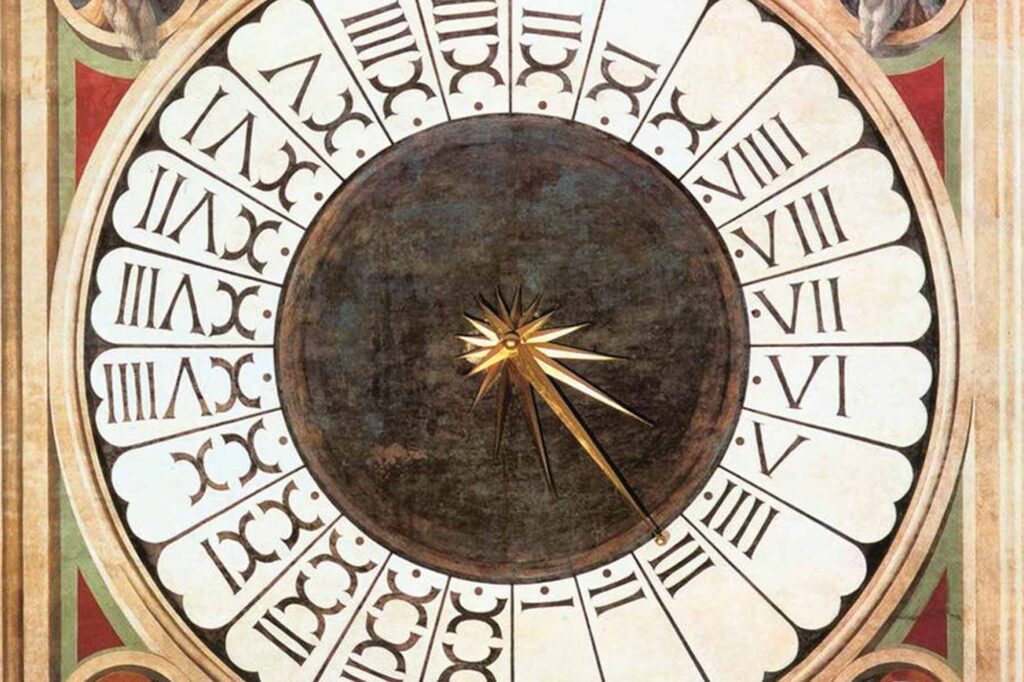
He also commissioned the Dominican mathematician and cosmographer Egnazio Danti to design astronomical timekeepers that displayed not only the hours but the positions of celestial bodies. Cosimo I was also involved in the restoration of the monumental Duomo Clock in Florence Cathedral, originally by Paolo Uccello, preserving it as a civic and dynastic symbol.
A court culture of complex instruments
The Medici world valued instruments that combined calculation, display and artistry. One example associated with this culture is a richly decorated astronomical table clock by Caspar Rauber, made in Germany around 1575 and held by the Museo Galileo.
The clock’s pavilion-shaped case includes a fretworked dome topped by an armillary sphere. Its sides carry multiple dials with different functions. One large dial is of the planispheric astrolabe type, with an external hour circle and a reversible tympanum for locating stars and determining planetary hours. It is set for latitude 48 degrees on one side and 40 degrees on the other.
Another reversible dial displays months, dates, major saints’ days, the changing length of light and darkness between dawn and sunset, and hour calculations. The armillary sphere, with Earth at the center and a small magnetic compass in the base, is operated manually.
The clock includes chimes for hours, quarter-hours and minutes under the dome. Its alarm mechanism is missing. The iron movement has three spring-driven trains inside barrels with a fusee mechanism: one for timekeeping, one for the hour chime and one for the minute chime. The piece was likely made for Maria Cristina of Lorraine, wife of Grand Duke Ferdinando I de’ Medici, Cosimo I’s son, and remained in Medici possession. It was restored to working order in 1878.
Astrolabes, Galileo and the Medici legacy
Several elaborate astrolabes and planetary clocks were made for court display, underscoring Medici sophistication. One important astrolabe by Egnazio Danti has a single tympanum for the latitude of Florence, 43 degrees 40 minutes. It sits on an adjustable octagonal table and includes a rete and an alidade.
The instrument also features a calendar with month names, a shadow square, a zodiac circle, a Tychonic scale for dividing degrees into twelve parts, a wind rose and a degree scale. Preserved in the Uffizi Gallery, it was used by Galileo for astronomical calculations and is therefore known as “Galileo’s astrolabe.”
The Medici family supported Galileo’s scientific work. In return, he tutored family members, including Cosimo II, who later appointed Galileo as his personal mathematician and philosopher after becoming Grand Duke.
Public clocks and civic order in Florence
In Florence’s Piazza della Signoria, the Palazzo Vecchio stands as one of the city’s defining civic buildings. Cosimo I made it his residence and altered the structure further. The clock on its tower has its own long public history.
Florence’s first public clock was made by the Florentine clockmaker Niccolò di Bernardo around 1353. It was replaced in 1667 by a clock built by George Lederle di Augusta and later modified by Vincenzo Viviani. It remains in working order and has a single hand with a counterweight.
For Renaissance rulers, public and courtly timepieces communicated order. Clocks could suggest divine harmony, civic discipline and the ruler’s command over public life. In Cosimo I’s case, commissioning and preserving such instruments helped frame his rule as both political and cosmic in scope.
Private timepieces and diplomatic gifts
Cosimo I owned finely made pocket watches and table clocks, including works by Augsburg and Nuremberg masters. Some were decorated with Medici arms. As in other European courts, such pieces could function as diplomatic gifts for foreign rulers and ambassadors.
These were portable expressions of refinement and alliance. Their value lay not only in material and mechanism, but in what they said about the court that offered them.
The Medici tradition after Cosimo I
The Medici interest in extraordinary timepieces continued after Cosimo I. A later example is the Florentine court cabinet and clock made in 1704–1705 by Leonard van der Vinne and Giovanni Battista Foggini for Anna Maria Luisa de’ Medici, daughter of Grand Duke Cosimo III.
Anna Maria Luisa was married to the Elector Palatine, Johann Wilhelm von der Pfalz. After his death, she returned to Florence. She became the last Medici to live in the Pitti Palace and left the Medici treasures to the Florentine state on the condition that nothing be removed from Florence.
The cabinet and clock were produced in the Grand Ducal workshops. Foggini, appointed Grand Ducal sculptor in 1687 and later court architect and director of the Galleria dei lavori, was one of the leading artists involved. The piece includes the use of calcedonio di volterra, a pink stone whose natural color was used to enhance the flesh-like appearance of the face of Dionysos in its central panel.
Why Cosimo I’s clocks still matter
Cosimo I’s patronage helped establish a Medici tradition in which scientific instruments carried artistic, political and intellectual weight. Many of these objects now form part of the heritage represented by Florence’s Museo Galileo.
Seen together, the clocks, astrolabes, quadrants and planetary models reveal a Renaissance world in which science and rulership were intertwined. For Cosimo I de’ Medici, measuring time and mapping the heavens were not separate from governing. They were part of the same visual language of authority.